

Table of Contents
- Why Your Current MTG Card Storage Ideas Are Failing You
- The Decision Matrix: How to Choose Your Sorting Method
- The Best Way to Sort Bulk Magic Cards Without Losing Your Mind
- Binders vs. Boxes: What Works for Deck Building and Trading
- Displaying MTG Cards: Self-Standing Shelves That Show Off Your Best Pulls
- Digital Inventory Integration and Climate Control for Long-Term Preservation
- Conclusion
- Frequently Asked Questions
Last Updated: September 28, 2026
Why Your Current MTG Card Storage Ideas Are Failing You
Most collections don't collapse because of neglect. They collapse because the system was never designed for the moment it hit five figures. If you've ever spent twenty minutes hunting for a single Lightning Bolt while a trade offer sat waiting, you already know the real cost of bad organization isn't the mess, it's the lost games, lost trades, and lost value.
The best way to organize MTG cards isn't one method.
The Decision Matrix: How to Choose Your Sorting Method
Choosing a sorting method is a decision about how you actually play, not about what looks tidiest on a shelf. Answer three questions first: How often do you build new decks? Do you trade actively? Are you holding cards for value or for play?
That gives you a decision matrix:
| Your Priority | Sort By | Storage Type | Time Investment |
|---|---|---|---|
| Fast deck building | Color identity + card type | Binders by format | High upfront |
| Active trading | Set, block, and rarity | Boxes with labeled dividers | Medium |
| Long-term value holding | Rarity and condition | Sleeved, climate-controlled | Low ongoing |
| Casual kitchen-table play | Color only | Bulk boxes | Minimal |
Sorting by Color Identity and Card Type
Color identity sorting groups cards by White, Blue, Black, Red, Green, multicolor, colorless, and lands, then subdivides by creature, instant, sorcery, enchantment, and artifact. It's the fastest route to deck building because your brain already searches in those categories.
Sorting by Set, Block, and Rarity
Set-and-block sorting keeps expansions together, which makes set rotation painless and trading simpler. Subdivide within each set by rarity: mythics, rares, uncommons, commons, then foils separated out entirely.
The Best Way to Sort Bulk Magic Cards Without Losing Your Mind
The best way to sort bulk Magic cards is to sort in passes, not all at once. Each pass has one job, and you don't move to the next until the current one is done. That single rule is what keeps a 5,000-card box from turning into a six-month floor pile.
Here's the pass structure that works for most collectors:
- Pass one, pull the money. Separate rares, mythics, foils, and anything on your watchlist from everything else. Don't sort by color yet. Just get the valuable cards out of the pile and into sleeves. A 5,000-card bulk box typically takes two to three hours for this pass alone, so break it across sessions.
- Pass two, split by color. Take the remaining commons and uncommons and divide them into White, Blue, Black, Red, Green, multicolor, colorless, and lands. Don't subdivide by type yet. Color-only piles are fast because your brain can classify a card in under a second.
- Pass three, pull uncommons. Uncommons are where spikes hide. Go through each color pile and pull uncommons into their own stack. Commons go straight into a long box and stay there.
- Pass four, subdivide playables. Within each color, split creatures, instants, sorceries, enchantments, and artifacts. This is the pass that makes deck building fast later, but it's also the slowest, so only do it for colors you actually build with.
Managing Commons, Uncommons, and Rares
Commons are the volume problem. Keep them in long boxes, sorted by color, and don't sleeve them unless they're playable in a format you actually run. A 5,000-count long box holds roughly 5,000 unsleeved cards, so one box per color is usually enough for a mid-size collection.
Binders vs. Boxes: What Works for Deck Building and Trading
Binders win for trading and deck building. Boxes win for volume and long-term storage. Most collections need both, and the mistake is picking one and forcing it to do everything.
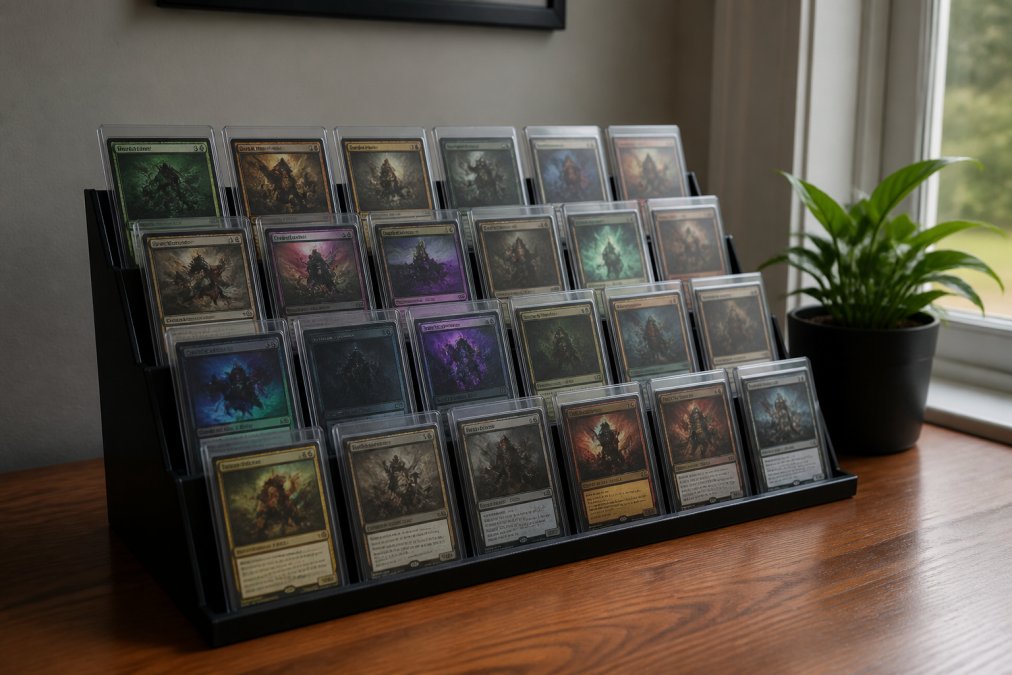
Displaying MTG Cards: Self-Standing Shelves That Show Off Your Best Pulls
Digital Inventory Integration and Climate Control for Long-Term Preservation
Two things separate a collection that holds value from one that quietly degrades: a digital inventory and stable storage conditions. Neither gets talked about enough in sorting guides, and both matter more the larger your collection grows. This is the part of organization most competitors skip entirely, so it's worth doing properly.
Trading Card Display Shelf – MTG, TCG →
Building a Digital Inventory That Matches Your Physical System
A digital inventory is a searchable record of what you own, where it's stored, and what it's worth. The key is that it mirrors your physical layout. If your cards are sorted by color and type, your inventory should be filterable by color and type. If they're sorted by set, your inventory should be filterable by set. A digital list that doesn't match the shelf is just a second pile of work.
Most collectors use one of three approaches:
- Scanning apps. Mobile apps that use your phone camera to identify cards and add them to a database. Fast for large batches, but accuracy varies on older printings and foils, so spot-check as you go.
- Spreadsheets. A simple sheet with columns for name, set, rarity, condition, location, and estimated value. Slower to build, but fully customizable and free. This is what most long-term collectors eventually land on.
- Dedicated collection trackers. Web-based tools built specifically for trading card games, with pricing feeds and deck-building integration. Best for active players who trade often.
Climate Control and Long-Term Preservation
Climate control is the quieter issue. Cards warp, fade, and develop moisture damage in unstable conditions, and the damage is usually invisible until it's too late to reverse.
The practical rules most preservation-minded collectors follow:
- Keep cards out of direct sunlight. UV exposure fades ink and yellows sleeves. A shelf in a bright room is fine; a shelf in a sunbeam is not.
- Avoid damp basements and hot attics. Both swing in temperature and humidity, which is what warps cards. A closet or interior room with steady conditions is safer than either extreme.
- Aim for stable humidity, not zero humidity. Very dry air makes cards brittle; very humid air invites moisture damage and mold. A simple hygrometer is enough to monitor the room.
- Match sleeve and box materials to storage length. Penny sleeves are fine for bulk. Rigid sleeves, toploaders, and acid-free boxes are for anything you're holding long-term. Cheap cardboard that off-gasses can damage cards over years.
- Store vertically, not stacked flat. Long boxes stored upright keep pressure off the bottom cards and make retrieval easier.
A digital inventory tells you what you own. Climate control keeps it worth owning. Together they're the difference between a collection and a pile.
Conclusion
The best way to organize MTG cards comes down to matching your system to how you actually play, then maintaining it in passes instead of one heroic sorting session. Bulk gets boxed, playables get binders, and your best pulls get displayed where you can enjoy them.
Frequently Asked Questions
What is the best card organizer for MTG?
The best organizer depends on your collection size and how you play. For active deck builders, a binder sorted by color identity keeps frequently used cards accessible. For bulk storage, long boxes organized by set and rarity work well. For showcasing high-value cards, a self-standing tiered display shelf keeps your best pulls visible and protected without taking up wall space.
How should I organize my MTG bulk?
Start by separating bulk into commons, uncommons, and rares. Then sort each pile by set, followed by color identity or alphabetical order. Store them in labeled long boxes or card boxes. This sorting workflow makes it easy to find cards for deck building and helps you identify which bulk is worth trading or selling later.
Is it better to keep cards in binders or boxes?
Binders suit cards you browse often, such as trade stock or deck-building staples, because you can flip through them quickly. Boxes handle large volumes of commons and uncommons more efficiently and cost less per card stored. Many collectors use both: binders for rares and foils, boxes for bulk.
How do I keep my favorite MTG cards accessible and visible?
Use a self-standing tiered display shelf designed for trading cards. These shelves hold cards in top loaders or hard cases and sit on your desk or shelf. The Card Shelf Workshop offers modular options that hold 16 to 20 cards per shelf, so you can expand as your collection grows.
What is the best sorting algorithm for cards?
There is no single best algorithm, but a layered approach works well: sort by set first, then rarity, then color identity, and finally alphabetical order within each color. This method scales from small collections to thousands of cards and makes deck building faster because you always know where a specific card lives.
If your collection has outgrown its boxes and you want the showcase pieces visible instead of buried, The Card Shelf Workshop builds self-standing, modular display shelves for singles, top loaders, graded slabs, and full decks. The tiered designs hold their shape, expand as your collection grows, and come in custom colors to match your space. Get started with The Card Shelf Workshop and give your best pulls the display they've earned.