

Table of Contents
- Why Slab Organization Matters More Than You Think
- 1. Start With a Sorting Methodology Before You Buy Anything
- 2. Graded Card Display: Getting Slabs Out of Boxes and Into View
- 3. PSA Slab Storage Solutions for High-Volume Collections
- 4. Archival-Grade Protection and Climate Control for Long-Term Preservation
- 5. Digital Inventory, Insurance, and Documentation
- 6. DIY vs. Commercial Storage: What Actually Works
- 7. Building a Collector Workflow That Scales With Your Collection
- Frequently Asked Questions
Last Updated: September 28, 2026
Why Slab Organization Matters More Than You Think
The best ways to organize trading card slabs start with one uncomfortable truth: most collectors store their most valuable trading card slabs in the worst possible conditions. A graded slab thrown into a shoebox loses value the moment its case gets scratched, and a stack of slabs pressed together invites warping and label damage. This guide from The Card Shelf Workshop walks through the systems serious collectors use to sort, store, and show off their graded holdings.

Grading a card is an investment. PSA, BGS, and CGC slabs protect and authenticate what you own, but they do not organize themselves. The storage decision you make after grading determines whether your collection stays a pile or becomes a collection with a system behind it.
That distinction matters more than most people admit. A disorganized collection is harder to insure, harder to sell, and harder to enjoy. The collectors who get the most out of their slabs are the ones who treat organization as part of the hobby, not an afterthought.
Below, we break down seven approaches that work, from sorting methodology to digital cataloging.
1. Start With a Sorting Methodology Before You Buy Anything
The biggest mistake collectors make is buying storage before deciding how they want to find things. Sorting methodology is the framework you use to decide where any given slab belongs. Get that wrong and no container will save you.
There are two dominant approaches, and most collections benefit from combining them.
Sort by Set and Card Number
Set-and-number sorting mirrors how the cards were originally released. A complete Pokémon Base Set goes together, in numerical order, in one section. This works best for collectors chasing complete sets, team sets, or a specific era.
The advantage is retrieval speed. If you know a card is #4 in a set, you know exactly where it lives. The drawback is that value gets ignored, so a low-value common sits beside a grail simply because the numbers are adjacent.
Sort by Value, Team Sets, or Personal Importance
Value-based sorting puts your highest-graded slabs where they are easiest to reach and display. Team sets work for sports collectors who group by franchise. Personal importance sorting is the wildcard: it lets sentiment drive placement, which is fine if you accept that your collection is not purely an asset.
A practical hybrid: sort the bulk by set, then pull your top tier of slabs into a separate display grouping. That way your showpieces stay visible while the rest stays findable.
2. Graded Card Display: Getting Slabs Out of Boxes and Into View
A graded card display turns a storage problem into a feature of the room. Slabs are built to be seen, and a tiered, self-standing shelf lets you show them off without hiding the labels or the card art.

Here is where organization and enjoyment overlap. Boxes protect slabs but hide them. Display shelves do both, provided they are designed for slab thickness and weight.
The Card Shelf Workshop's Modular Graded Card Display Shelf is a solid starting point for most collectors. The 3x3 baseline unit holds nine slabs and uses a no-obstruction design so labels and card art stay fully visible. It expands with additional 3x1, 3x2, or 3x3 "With Pins" packs that lock together with heavy-duty alignment pins, so you can build a 6x3 or 5x3 display as your collection grows.
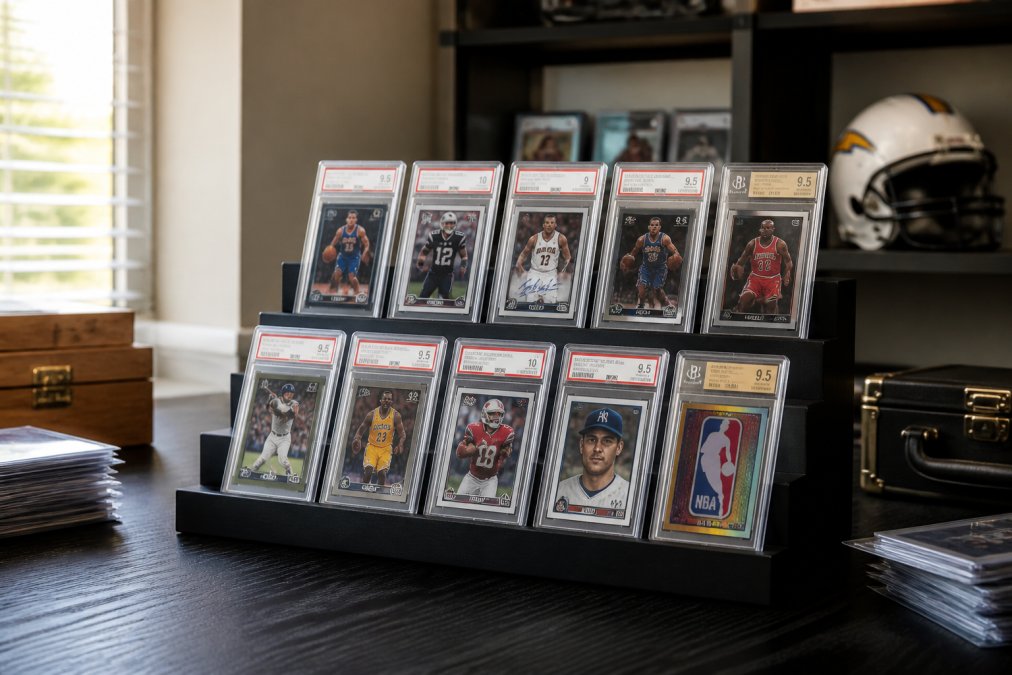
Standard slots accept slabs up to 0.375 inches thick, which covers most PSA, CGC, and BGS cases. If your slabs use thick outer acrylic guards or silicone bumpers, the Heavy-Duty 3x3T version widens the channels to 1/2 inch.
For a desk-based alternative, the 4x4 Graded Card Display Stand holds 16 slabs in a grid matrix and breaks into two pieces for travel to card shows. It accommodates cases up to 13mm thick, so chunky patch and autograph slabs fit without forcing.
Modular Graded Card Display Shelf for →

3. PSA Slab Storage Solutions for High-Volume Collections
PSA slab storage solutions for high-volume collections come down to three container types, each with a different job. Knowing which one fits your situation prevents the common mistake of buying the wrong container for the wrong tier of your collection.
Storage Boxes, Hard Plastic Cases, and Protective Sleeves
Storage boxes handle the bulk. They are the workhorse for commons, mid-tier slabs, and anything you are not displaying right now. Look for boxes sized specifically for graded slabs rather than raw cards, since slab dimensions differ from standard cards.
Hard plastic cases add a second layer for your highest-value pieces. A slab already protects the card, but an outer case absorbs the knocks that would otherwise scuff the slab itself.
Protective sleeves sit between the two. They are cheap, they prevent surface scratches during handling, and they let you slide a slab in and out of a box without direct contact.
| Storage Type | Best For | Protection Level | Access Speed |
|---|---|---|---|
| Storage boxes | Bulk and off-display slabs | Moderate | Slow |
| Hard plastic cases | High-value, frequently handled slabs | High | Moderate |
| Protective sleeves | Daily handling and transport | Low | Fast |
| Self-standing display shelf | Showpiece slabs | Moderate | Fast |
4. Archival-Grade Protection and Climate Control for Long-Term Preservation
Archival-grade protection and climate control decide whether your slabs look the same in ten years as they do today. Card condition is the single biggest driver of valuation, and the environment around a slab does slow, quiet damage if you ignore it.
5. Digital Inventory, Insurance, and Documentation
Digital inventory is the organizational layer most collectors skip, and it is the one that pays off fastest. A spreadsheet or inventory app that records each slab's grade, serial number, and current valuation gives you a single source of truth.
A minimal inventory record should include:
- Card name, set, and card number
- Grading company and grade
- Serial number from the slab label
- Purchase date and price
- Current estimated valuation
- Photo of the slab, front and back
6. DIY vs. Commercial Storage: What Actually Works
DIY storage works for small collections and tight budgets, but it stops working the moment your collection outgrows a shoebox. Commercial display and storage systems cost more upfront and save you from re-sorting every few months.
7. Building a Collector Workflow That Scales With Your Collection
A collector workflow is the repeatable process you follow every time a new slab enters your collection. It scales because it does not depend on your memory or your free time.
- Grade or acquire the slab
- Photograph it and log it in your inventory
- Assign it to a sorting category
- Place it in display or storage based on that category
- Re-evaluate placement quarterly
Frequently Asked Questions
What is the best way to organize my trading card slabs?
Start with a sorting methodology before buying storage. Sort by set and card number for set registry builds, or by value and personal importance for display collections. Then match storage to the goal: self-standing tiered shelves for cards you want visible, storage boxes for overflow, and hard plastic cases for extras. A modular graded card display shelf lets you expand as the collection grows, so you are not rebuying storage every year.
What are the best PSA slab storage solutions?
PSA slab storage solutions fall into two main groups: display shelves and storage boxes. For active collections, a modular display shelf keeps slabs accessible and visible. For overflow, use storage boxes lined with protective sleeves. The key is matching each slab to the right tier so your most valuable cards get the most protection and the most visibility.
How can I display my slabs without damaging them?
Keep slabs out of direct sunlight, since UV exposure fades card art over time. Use a shelf with angled tiers so each slab sits securely and labels stay readable. Avoid stacking slabs flat under heavy weight, which can stress the acrylic case. A tiered display shelf with dedicated slots holds each slab upright, keeps card condition stable, and lets you rotate pieces without handling them constantly.
How do you categorize graded cards for easy access?
Categorize by what you actually do with the cards. If you build set registries, sort by set and card number. If you track value, sort by grade and estimated valuation. If you display favorites, sort by team sets or personal importance. Label each shelf section so you can find a slab in seconds. A consistent sorting methodology matters more than which one you pick, because it keeps the collection trackable as it grows.
What are the benefits of using tiered display shelves for slabs?
Tiered display shelves keep every slab fully visible, so labels and card art are not blocked by the row in front. They hold slabs upright at a stable angle, which reduces handling and the risk of drops. Self-standing tiered designs need no wall mounting, so they work in apartments and rental spaces. Modular versions expand with your collection, letting you add rows instead of replacing the whole setup.