

Quick Summary
The best card storage alternatives to BCW Supplies depend on how you collect. Bulk storage boxes protect large volumes cheaply, while self-standing tiered display shelves let you see graded slabs, toploaders and decks. Many collectors combine a storage box for bulk with a display shelf for favourites.
- Storage boxes suit bulk collections and cards you rarely handle, but offer little display value.
- Box capacity is stated in cards or sleeves, and a rigid holder takes more room than a sleeve.
- A 3,000-count box holds roughly 1,200 to 1,500 sleeved MTG cards, depending on sleeve thickness.
- Measure your thickest card holder before checking the slot dimensions of any display shelf.
- Our self-standing tiered shelves sit on a desk or cabinet and need no drilling into walls.
Table of Contents
- Why Collectors Look Beyond BCW Supplies
- Choosing Card Storage Boxes for Bulk Collections
- Magic: The Gathering Card Storage Options Compared
- Graded Card Display Stands and Self-Standing Tiered Shelves
- Trading Card Organization Ideas for Easy Browsing
- Side-by-Side Comparison: Fit, Materials, Capacity and Cost
- Picking the Right Setup for Your Collection Next
- Frequently Asked Questions
5 Alternatives to BCW Supplies for Card Collectors
Last Updated: November 5, 2026
The Card Shelf Workshop builds self-standing tiered display shelves for collectors who want their cards out of the box and on show. Many collectors reach for BCW Supplies first, and for good reason, but a display-focused alternative often suits a growing collection better than another stack of storage boxes.
Card storage alternatives fall into a few clear groups: bulk storage boxes, graded slab stands, tiered display shelves, and organization systems for browsing.
Why Collectors Look Beyond BCW Supplies
Most collectors start with a single storage box and then find that their collection outgrows it. A box keeps cards protected but hides them, so a graded slab you are proud of sits in the dark until you dig it out.
Collectors also look elsewhere when they want:
- Visibility: cards you can see without unpacking anything
- Modularity: shelving that expands as the collection grows
- Fit for thick cases: graded slabs and thick cases do not always sit well in standard holders
- A different price point: a single purchase sized to a specific collection
The Card Shelf Workshop focuses on that visibility gap, with display stands for graded slabs, toploaders and decks. Whether you need an alternative depends on what you are trying to achieve, so this guide keeps the comparison practical rather than declaring one winner.
Choosing Card Storage Boxes for Bulk Collections
If your priority is protecting a large number of cards in one place, a storage box is still the sensible starting point. Storage boxes suit bulk collections, cards you rarely handle, and anything you want kept out of sight.
Before buying, check three things:
- Card thickness: make sure the box takes the sleeves and holders you actually use
- Closure: a secure lid matters more than size for long-term storage
- Future growth: buy a box that leaves room for the cards you expect to add
Storage boxes work well as the "back room" of a collection, with display pieces handling the cards you want to show off. Many collectors combine the two.
Matching Box Capacity to Your Collection Size
Box capacity is usually stated in cards or in sleeves, and the two figures are not interchangeable. A box rated for a few hundred sleeved cards may hold far fewer toploaders, because each rigid holder takes more room. Count the holders you use, not the cards, before you pick a size.
A simple approach: count your current collection in the format you store it, then add roughly a third for growth. Choosing a box that is just big enough today usually means buying a second one within a year.
Magic: The Gathering Card Storage Options Compared
Magic: The Gathering collections are rarely one uniform stack. A typical player owns a mix of sleeved decks, loose singles in penny sleeves, bulk commons, and a few valuable cards in rigid holders.
Here is how the main storage directions compare for MTG specifically:
- Cardboard storage boxes (BCW-style or generic): The standard for bulk. A 3,000-count box holds roughly 3,000 unsleeved cards or about 1,200-1,500 sleeved cards, depending on sleeve thickness. They are cheap and stackable but offer zero visibility. For MTG, a 800-count box is a common starting size for a single player's bulk, while a 3,000-count box suits a collection shared by a playgroup.
- Deck boxes: Designed for a single 60-card deck plus sideboard, usually holding 75-100 double-sleeved cards. Ultra Pro, Ultimate Guard, and Gamegenic all make models with dice compartments. These are for transport and quick access, not long-term bulk storage.
- Binders and portfolios: Best for trades and browsing. A 9-pocket page holds 18 cards front and back, and a 360-card binder covers a full set. Side-loading pages reduce the risk of cards catching on the ring or page edge. For MTG, binders work well for rares and mythics you want to show, but they are not archival for high-value cards unless you use acid-free pages.
- Graded slab cases: If you own graded MTG cards (PSA, BGS, CGC), standard boxes do not fit them. Slab-specific cases or self-standing tiered display shelves hold them upright and visible. Our shelves are self-standing tiered displays, not wall-mounted, so they sit on a desk or cabinet and keep slabs accessible without drilling.
A practical MTG setup often combines two or three of these: a 3,000-count box for bulk, a binder for trades, and a self-standing tiered shelf for the decks and cards you use most.

Sleeve and Holder Compatibility for MTG
MTG cards are standard size (63 x 88 mm), but sleeves vary. A double-sleeved card (inner sleeve plus outer sleeve) can be 1-2 mm thicker than a single-sleeved one, which affects how many fit in a box or deck box. Before buying any storage, measure a representative card in the exact sleeve you use.
Check the slot dimensions listed for each shelf against your thickest holder before you order.
Graded Card Display Stands and Self-Standing Tiered Shelves
Graded slabs are thick and rigid, and they often do not fit standard boxes. Graded card display stands hold slabs upright in a fixed grid, where they are visible.
The graded display shelves are self-standing tiered displays. They sit on a desk, shelf or cabinet top.
Graded Card Display Shelf for PSA BGS CGC Slabs | Collectible Trading Card Stand →

Look for these details when comparing graded stands:
- Slot thickness: check it accepts your slabs, including any thick outer guards
- Tier spacing: enough vertical room so one slab does not cover the label of the one below
- Expandability: whether you can add shelves as the collection grows
Check the fit notes for the specific model before you buy.
Trading Card Organization Ideas for Easy Browsing
Most organization advice stops at "sort by set." That works until you have multiple games, graded slabs, and decks competing for the same space. A browsing-friendly system needs to answer three questions quickly: where is a specific card, which cards are ready to trade or play, and what is on display. The following setups address those questions with concrete methods rather than general tips.
Method 1: The Three-Zone System
Divide your collection into three physical zones: archive, active, and display.
- Archive: Bulk cards and duplicates you rarely touch. Store in labeled cardboard boxes by set and color. Use a simple label like "M21 - Blue - 400ct" so you can find a box without opening it.
- Active: Decks, trade binders, and cards in current use. Keep these in a dedicated area, such as a binder for trades and a deck box for each built deck. Label the spine of each binder with the set or format.
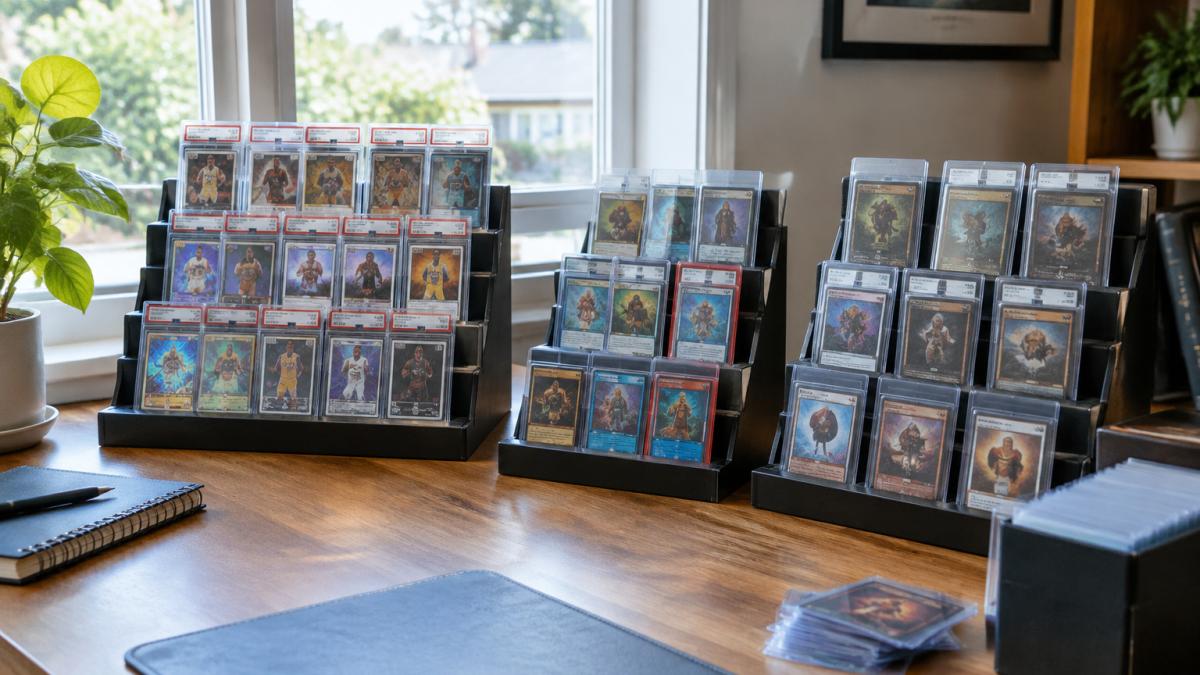
- Display: The cards you want to see daily. This is where a self-standing tiered shelf earns its place. Assign each tier a category, graded slabs on top, favorite decks in the middle, toploaded singles on the bottom, so the shelf itself becomes a visual index.
The three-zone system works because it separates storage from display and keeps the cards you handle most in the most accessible spot.
Method 2: Label by Set Code and Rarity
For collections over a few thousand cards, use the official set code (e.g., "DMU" for Dominaria United) plus rarity on every box and binder spine.
For graded cards, label by certification number and grade on the back of the slab or on the shelf slot, not on the slab face. This keeps the display clean and avoids adhesive residue on the holder.
Method 3: Tiered Display as a Browsing Tool
A self-standing tiered shelf is not just for show. Because each tier is at a different height, you can organize by frequency of use: top tier for cards you show off, middle tier for cards you trade or play regularly, bottom tier for cards in long-term display. This turns the shelf into a working part of your organization system rather than a static display.
Method 4: Digital Index for High-Value Cards
For cards worth tracking, a simple spreadsheet or a scanning app (many collectors use TCGplayer or Dragon Shield apps) can log card name, set, condition, and location.
A common pattern is to index only cards above a certain value threshold, since indexing every common is not worth the time. Most collectors find that indexing cards worth more than a few dollars covers the ones they actually need to locate.
Combining Methods
The strongest setups combine two or three of these. For example: three-zone system for physical separation, set-code labels for archive boxes, and a tiered display shelf for the active and display zones. The goal is not a perfect system but one where you can find any card in under a minute and see your favorites without opening a box.
Side-by-Side Comparison: Fit, Materials, Capacity and Cost
| Option | Best for | Capacity | Visibility | Materials | Starting price |
|---|---|---|---|---|---|
| Graded Card Display Shelf (PSA/BGS/CGC) | Graded slabs | 16 slabs (4x4) | High | 3D-printed PLA | $44.99 |
| Modular Graded Display Shelf (3x3) | Growing slab collections | 9 slabs per block, expandable | High | 3D-printed PLA | $36.99 |
| Trading Card Display Shelf (MTG/TCG/graded) | Toploaders and sleeved cards | 16 or 20 cards | High | 3D-printed PLA | $39.99 |
| Top Loader Display Shelf | Standard rigid toploaders | 16 or 20 toploaders | High | 3D-printed PLA | $44.99 |
| Wall Mount or Desk Stand | Small collections, flexible use | 1 to 4 cards | Medium | 3D-printed PLA | $7.99 |
Check the fit notes before you order.
Picking the Right Setup for Your Collection Next
Start with what you own and what you want to do with it. If your cards mostly live in boxes and you rarely look at them, a storage box is enough.
Measure your thickest card holder, count how many cards you want on show, and check that the shelf you choose matches those numbers. Browse the Card Shelf Workshop range to find a self-standing tiered display sized for your collection.
Frequently Asked Questions
What are the best alternatives to BCW card storage boxes?
Good alternatives to BCW boxes depend on what you need: storage boxes for bulk cards, sleeves and top loaders for individual protection, or self-standing tiered display shelves for showing cards. Compare each option on fit, capacity, material and price before buying. Check card thickness and slab size against each listing, since a box that suits standard sleeved cards may not hold thick graded slabs. For a display setup, The Card Shelf Workshop offers self-standing tiered shelves in several grid sizes, starting at 7.99 for a single-card shelf and 36.99 for the modular 3x3 graded slab stand.
What can I use instead of BCW boxes for bulk Magic: The Gathering cards?
For bulk Magic: The Gathering cards, look at storage boxes sized for standard sleeved cards, then compare them on capacity, closure and how easily you can browse the contents. Separate dividers help keep sets organized. Rigid holders suit valuable individual cards, while boxes suit bulk. If you want to display a selection of cards, a self-standing tiered shelf keeps them visible and accessible without taking them out of storage.
How should I store and display graded trading cards?
Graded slabs are thicker than standard cards, so check the slot thickness before buying any stand. The Card Shelf Workshop's Modular Graded Card Display Shelf accepts standard slabs up to 0.375 inches (10mm), and its heavy-duty 3x3T version accepts slabs up to 0.5 inches (13mm) for thick guards. The Graded Card Display Shelf for PSA, BGS and CGC slabs holds 16 slabs in a 4x4 grid and is designed for travel because it ships disassembled.
Are cardboard or plastic card storage boxes better?
Cardboard boxes are inexpensive and easy to find, but they offer less protection against moisture and crushing. Plastic boxes are sturdier and easier to clean, and they usually close more securely. Choose based on how the collection will be stored and handled. For cards you want to see, a self-standing display shelf may suit you better than either type of box.
