

Last Updated: November 14, 2026
Quick Summary
To arrange amiibo and miniatures on tiered shelves, sort figures by height, place the tallest on the back or top tier, and put the smallest at the front. Measure tier clearance first so your tallest figure fits, and group each tier by theme.
- Measure each tier's clearance and your tallest figure before placing anything.
- Sort figures by height first, then pick a theme for each tier.
- Place the tallest figures on the back or top tier and the smallest at the front.
- Leave a finger-width gap, about 0.5 inch, between figures so each stays visible.
- Put heavy figures on lower tiers and keep the stand on a level surface.
Table of Contents
- Why Tiered Shelves Work for Amiibo and Miniatures
- Measure Your Self-Standing Shelf Before You Place Anything
- Step-by-Step: Arranging Figures by Height and Theme
- Tiered Figure Display Ideas for Different Collections
- Spacing and Visibility: Keeping Smaller Figures in View
- Keeping Your Self-Standing Display Stable and Dust-Free
- Choosing an Amiibo Display Stand for Your Collection
- Planning Your Next Shelf Layout
- Frequently Asked Questions
Why Tiered Shelves Work for Amiibo and Miniatures
Tiered shelves give every figure its own view. The Card Shelf Workshop builds self-standing tiered displays for collectors, so each row sits above the one in front of it. A tiered shelf makes amiibo and miniatures easy to see without crowding them together.
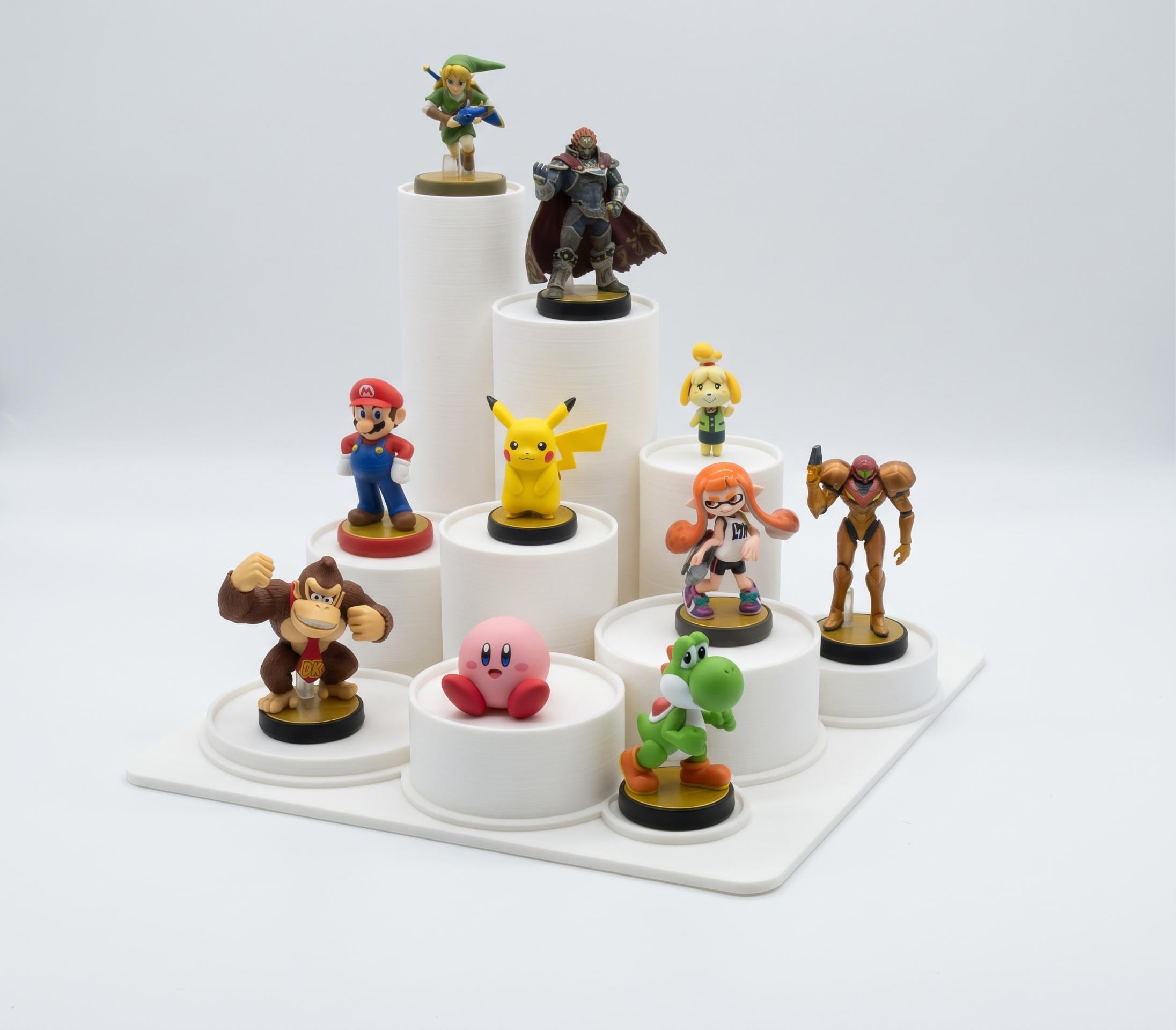
Here is why the layout works so well:
- Every figure stays visible. Each step lifts the figures behind it into view.
- It saves surface space. Stacking tiers uses height instead of spreading figures across a desk or cabinet.
- It highlights favorites. Placing a key piece on the top tier makes it the focal point.
- It grows with you. Adding a new figure means adjusting a tier, not rebuilding the whole display.
Because the shelves are self-standing, they sit on a table, desk or cabinet top. You can move them, rotate them or reposition them whenever your collection changes.
Measure Your Self-Standing Shelf Before You Place Anything
Measure before you unbox your figures. A few minutes with a tape measure prevents most of the frustration that comes from a crowded or unstable display. The goal is to know three things: how much footprint your shelf takes up, how much clearance each tier gives you, and how many figures you can realistically fit without blocking views.
Start with these checks:
- Measure the footprint. Note the width and depth of the base so you know where it fits on your table, desk, or cabinet top. A self-standing tiered shelf needs a flat, level surface at least as wide and deep as its base.
- Measure each tier's height. This is the vertical distance from the surface of one tier to the bottom of the tier above it. Taller figures need more clearance above them, so record the smallest clearance on the whole stand.
- Measure your tallest figure. Compare it to the smallest tier clearance to confirm it fits. If your tallest figure is taller than the clearance, it will either not fit or will block the tier behind it.
- Measure the usable depth of each tier. Figures sit on the tier surface, so the depth tells you how many rows of figures you can place front-to-back. Most amiibo and miniatures need about 1.5 to 2 inches of depth per row.
- Check the surface. A flat, level table or cabinet keeps the stand steady. An uneven surface can cause wobble or tipping, especially with a tall, loaded stand.
Once you have those numbers, do a simple capacity estimate. For each tier, divide the usable width by the average width of your figures plus a small gap (about a finger-width, or 0.5 inch). That gives you a rough count per row. Then multiply by the number of rows the tier depth allows. Add up the tiers and you have a realistic capacity for your shelf. If your collection is larger than that number, you know you need to rotate figures or plan for a second stand rather than cramming everything onto one.
Write the numbers down so you can plan your layout on paper first. Watch out: guessing the tier clearance is the most common cause of a tall figure that either does not fit or hides the row behind it.
Step-by-Step: Arranging Figures by Height and Theme
Arranging by height and theme gives a display a clear, planned look. Follow these steps:
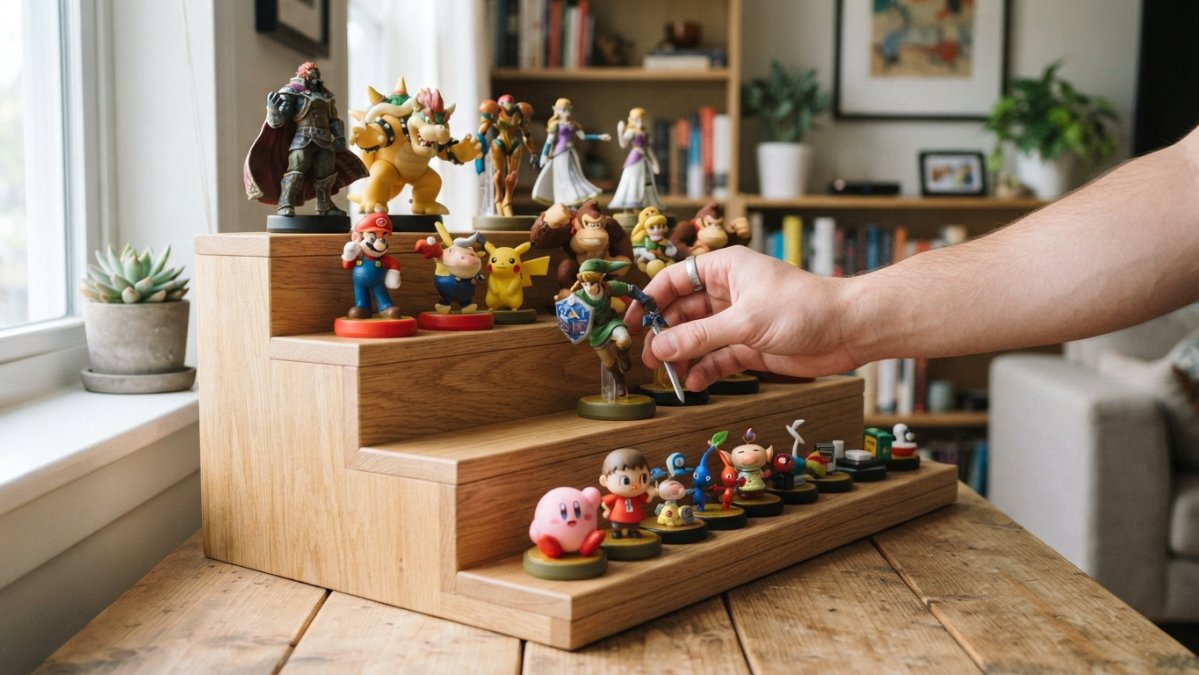
- Sort your figures by height. Group tall, medium and short figures.
- Pick a theme for each tier. For example, one tier for a game series, another for a favorite character group.
- Place the tallest figures on the back or top tier. This keeps shorter figures in view.
- Fill the middle tier with medium figures. Leave space between them so none blocks another.
- Put the smallest miniatures on the front tier. Small pieces stay visible when they sit in front.
- Step back and check the view. Look from where you normally stand and move any figure that hides another.
A common mistake is grouping by color alone. Sorting by height first keeps the display balanced, and theme groups add meaning.
Tiered Figure Display Ideas for Different Collections
Different collections need different layouts. Try one of these ideas:
- Amiibo-only display. Use one tier per game series for a clean, organized look.
- Mixed miniatures. Pair small miniatures with amiibo on the same tier to add variety.
- Character focus. Place a single favorite character on the top tier as the centerpiece.
- Seasonal rotation. Swap a tier's figures to refresh the display without buying a new stand.
Each layout works with a self-standing tiered shelf. Pick the one that matches how you collect.
Spacing and Visibility: Keeping Smaller Figures in View
Smaller figures are easy to lose behind larger ones. Use these spacing tips:
- Leave a gap between figures. A finger-width gap keeps each piece visible.
- Keep small figures near the front. Front placement keeps them in the line of sight.
- Avoid stacking tall figures in front. A tall figure in the front row can hide everything behind it.
- Angle figures slightly. A small turn lets light reach the face of each piece.
Check the display from your normal viewing position. If you cannot see a figure clearly, move the figure in front of it.
Keeping Your Self-Standing Display Stable and Dust-Free
A stable display protects your collection and your peace of mind. Because your shelves are self-standing rather than wall-mounted, stability depends entirely on how you load the tiers and where you place the stand. The good news is that a few consistent habits keep a tiered display steady even when it is full.
Start with weight distribution. Heavy figures belong on the lower tiers. A self-standing tiered shelf has a wider base than top, so putting the heaviest pieces low keeps the center of gravity down and reduces the chance of tipping. Spread weight across the tiers rather than concentrating it on one side. If one end of the stand feels heavier than the other, move a few figures to balance it.
Keep the stand on a level surface. An uneven table or a cabinet top that rocks can cause the whole display to wobble, and a wobbling stand is more likely to tip if bumped. Check the surface with a small level or by pressing on each corner. If the surface is not level, move the stand rather than trying to shim it, since shims can slip. A stable, level base matters just as much when arranging larger sports memorabilia, and SOK Sports connects that same care with displaying NFL collectibles in an office.
Avoid overloading the top tier. The top tier has the least support beneath it and the most leverage if the stand is bumped. Keep it to lighter figures and leave a little open space so the display does not feel top-heavy. A common pattern is to treat the top tier as a focal point for one or two favorite pieces rather than a storage row.
Dust regularly with a soft brush or microfiber cloth. Dust settles on tier surfaces and on figure details, and a soft brush reaches into small crevices without scratching paint. Avoid compressed air on painted miniatures, since the force can dislodge small parts. For amiibo, a dry microfiber cloth is usually enough; avoid solvents or wet wipes that can damage the finish.
Keep the display out of direct sun. Strong light can fade paint over time, and a self-standing shelf can be moved easily, so reposition it if it sits in a sunny spot. If you cannot avoid a bright room, rotate figures periodically so no single piece takes the full exposure.
Check the stand every few months. Make sure every tier sits flat, nothing wobbles, and no figure has shifted. A quick inspection takes a minute and catches small problems before they become tip-overs. Watch out: stacking heavy figures on the top tier is the most common cause of a self-standing display becoming unstable.
Stability depends on how you load the tiers and where you place the stand, so these habits matter most.
| Habit | Why it matters | How often |
|---|---|---|
| Place heavy figures on lower tiers | Lowers the center of gravity and reduces tipping | Every time you load |
| Keep the stand on a level surface | Prevents wobble and tipping | Check when you set up |
| Keep the top tier light | Top tier has least support and most leverage | Every time you load |
| Dust with a soft brush or microfiber cloth | Avoids scratching paint and damaging small parts | Regularly |
| Avoid compressed air on painted miniatures | Force can dislodge small parts | Whenever you clean |
| Keep the display out of direct sun | Strong light can fade paint over time | Ongoing |
| Inspect the stand for wobble or shifted figures | Catches problems before a tip-over | Every few months |
Choosing an Amiibo Display Stand for Your Collection
The right stand depends on how many figures you own and how much space you have. The Collectible Figurine Display Stand, Staircase Riser for Action Figures, Amiibo, Miniatures, Crystals, Funko Pop is a self-standing, tiered riser that comes in three sizes, so you can match it to your display area.
Consider these factors when you choose:
- Size. Pick a footprint that fits your table or cabinet.
- Tier count. More tiers suit larger collections.
- Figure size. Check that the tier diameters suit your largest figure.
- Stability. A wider base is steadier for tall displays.
Measure your space and your tallest figure, then compare them to the stand's listed dimensions before you buy.
Planning Your Next Shelf Layout
Before you add figures, sketch your layout. Write down the tier heights, the figure sizes and the theme for each tier. Then place the figures one tier at a time.
Plan for growth. Leave a little open space on one tier so new figures have room. When you are ready to expand, try a new arrangement that keeps the height and theme pattern you already use.
A planned layout makes your display easy to update. The Card Shelf Workshop builds self-standing tiered displays for collectors.
Frequently Asked Questions
How do you arrange Amiibo on tiered shelves?
Start with the tallest figures and place them on the back of the highest tier, then work forward and downward so each step shows the figures behind it. Group by theme or game where it helps the eye, and keep figures of similar size on the same tier. Before settling on a layout, stand the shelf on a flat surface and check that every figure can be seen from your usual viewing position. Rearrange until the display looks balanced, not crowded.
How can I keep smaller figures visible behind larger Amiibo?
Place smaller miniatures on the tiers closest to eye level and keep larger Amiibo toward the back or on the lower tiers where they will not block the view. A tier that is deep enough to leave a clear strip in front of each figure keeps smaller pieces visible. If a small figure is still hidden, move it one step forward or swap it with a figure of similar height on another tier.
How much space should I leave between figures on a tiered shelf?
Leave enough room that figures do not touch or overlap, and enough clearance that you can lift one out without moving its neighbours. Figures with wide bases or accessories need more room than slim ones. Check each tier against its depth so no figure sits at the edge, where it could be knocked off. Your own hands are the best test: if you cannot reach a figure comfortably, the spacing is too tight.
How do I keep a tiered figure display from looking cluttered?
Use fewer, larger groups rather than scattering single figures across every tier. Leave some empty space on each tier so the eye can rest. Stick to a consistent theme for each shelf or tier, and rotate pieces occasionally rather than adding more figures to a full shelf.
