

Table of Contents
- How to Display Graded Sports Cards: The Complete Setup
- Best Graded Card Display Stands for Your Collection
- How to Organize Graded Sports Cards by Value and Theme
- Tiered Display Shelves for Trading Cards: Setup and Placement
- Protecting Your Slabs: UV, Dust, and Environmental Factors
- Common Mistakes When Displaying Graded Sports Cards
- Frequently Asked Questions
Last Updated: October 4, 2026
How to Display Graded Sports Cards: The Complete Setup
The right way to display graded sports cards keeps them safe while showing off what you've collected. At The Card Shelf Workshop, we help collectors create displays that protect their investment and look great doing it. The key is matching your display method to your collection size and the space you have.
Understanding Your Slab Types and Compatibility
Graded cards come in different slab types, PSA, BGS, CGC, and SGC, with varying dimensions and thickness. Standard slabs measure around 0.375 inches thick; thicker cases like BGS and SGC heavy-duty versions reach up to 0.5 inches. Before choosing a display system, measure your thickest slab to ensure compatibility.
Choosing Between Display Formats
Self-standing tiered displays work best for most collectors. They require no installation and let you arrange cards at different heights so every slab is visible. Single-card stands work for a few premium slabs and let you rotate which card gets the spotlight.
Best Graded Card Display Stands for Your Collection
The right stand depends on how many cards you're displaying and the space available. Let's look at the main options.
Modular Expandable Systems
The Modular Graded Card Display Shelf for PSA BGS CGC is a self-standing tiered system that holds up to 9 slabs in a 3x3 configuration. Stack additional shelves using alignment pins to expand capacity. The system accommodates standard slabs up to 0.375 inches thick, with a heavy-duty version for thicker BGS or SGC cases up to 0.5 inches. Your shelf grows as your collection does.

Single-Tier and Multi-Card Options
The Graded Card Display Shelf for PSA BGS CGC Slabs offers a 4x4 grid in a single self-standing unit. It snaps together without tools, tilts cards forward for better viewing, and accommodates slabs up to 0.5 inches thick.

The Trading Card Display Shelf holds 1 to 4 cards in a compact self-standing footprint, ideal for starter collections.

| Display Type | Card Capacity | Best For | Thickness Support |
|---|---|---|---|
| Modular 3x3 | 9 cards | Growing collections | Up to 0.5 inches |
| 4x4 Grid | 16 cards | Showcase displays | Up to 0.5 inches |
| 1-4 Card Stand | 1-4 cards | Starter collections | Standard slabs |
| Multi-Tier Shelf | 16-20 cards | Large collections | Up to 0.375 inches |
How to Organize Graded Sports Cards by Value and Theme
Organization transforms a random collection into a curated display that tells a story about what you collect and helps you spot gaps in your collection.
Creating a Cataloging System Before Display
Before arranging cards on your shelf, document what you own to prevent duplicates and guide your arrangement strategy.
For each slab, record:
- Player name and sport (e.g., Michael Jordan, basketball)
- Card year and set (e.g., 1986 Fleer, 1952 Topps)
- Card number (e.g., #23)
- Grade and grading company (e.g., PSA 9, BGS 8.5, CGC 10)
- Estimated value (based on recent sales on eBay or PWCC Marketplace)
- Purchase date and cost (for insurance and collection tracking)
Use a spreadsheet like Google Sheets with a photo column for each slab. This protects you if something happens to the physical cards and reveals patterns in your collection.
Organizing by Grade Tier (Condition Progression)
Arrange by grade to showcase quality progression. Place PSA/BGS/CGC 9-10 cards at eye level, grades 8-8.5 above, and grade 7 and below lower. This arrangement communicates collection quality and creates visual balance. If you own multiple copies of the same card in different grades, this setup shows how condition affects value.
Organizing by Player or Team (Thematic Grouping)
Group cards by player (e.g., all Michael Jordan cards together) and arrange by year or grade within each group. Alternatively, organize by team if you collect multiple players from the same franchise.
Organizing by Era or Vintage vs. Modern
Create visual sections by era: Vintage (pre-1980) at eye level, Semi-vintage (1980-2000), and Modern (2000-present). Sub-organize by sport or player within each era to create clear visual boundaries.
Organizing by Investment Value (Advanced)
Place your highest-value cards at eye level as anchor pieces. Surround them with supporting cards of related theme (same player, era, or set). If you own multiple high-value cards, spread them across your shelf so each gets breathing room and attention.
Mixing Aesthetics with Function
Consider balance (prominent cards on both sides), color (use colorful art as focal points), spacing (at least a quarter-inch between slabs), and symmetry (align cards in rows). Step back and view your shelf from across the room to ensure it feels balanced and your eye lands on your best cards.
Rotating Your Display Seasonally
Rotate your display every 3-6 months to keep it fresh and protect cards from light exposure. This ensures even aging across your entire collection.
Tiered Display Shelves for Trading Cards: Setup and Placement
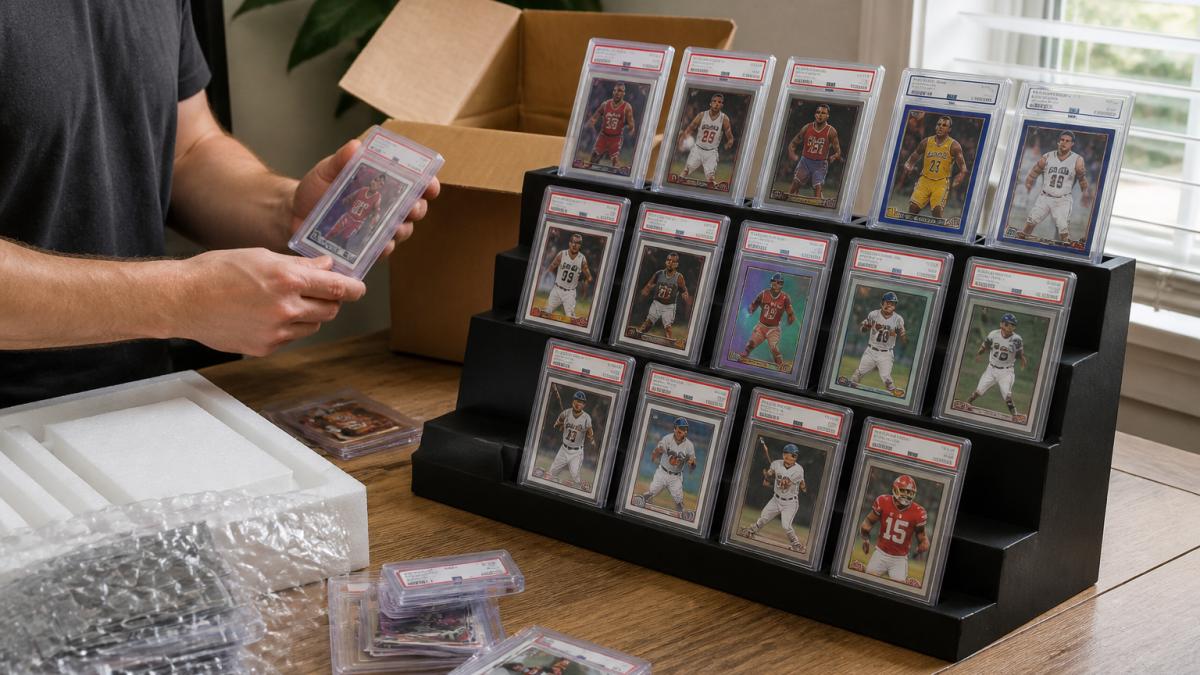
Tiered self-standing displays work because each level is visible. Nothing hides behind anything else. This matters when you're showcasing cards worth real money.
Maximizing Visibility and Spacing
Space your slabs evenly. Don't cram cards together. Leave at least a quarter-inch between each slab. This breathing room makes your display look professional and prevents cards from rubbing against each other.
Position cards so the slab label faces forward. Collectors want to see the grade, certification number, and card details. Angled displays tilt cards slightly forward, which improves visibility and photographs better.
Place your most valuable or favorite cards at eye level. When someone looks at your display, their eyes naturally focus on the middle. Put your showpiece slabs there.
Weight Distribution and Stability
Self-standing tiered displays are sturdy, but weight matters. Don't overload one shelf. Distribute cards evenly across all levels.
Check that your shelf sits on a flat, level surface. A wobbly desk or uneven floor transfers to your display. Adjust the feet or add shims until it's stable. A wobbly display risks tipping or cards sliding out.
If you stack multiple modular units, use the alignment pins provided. These pins lock shelves together and prevent shifting. Proper assembly keeps your display rock-solid.
Protecting Your Slabs: UV, Dust, and Environmental Factors
Graded cards are already protected by their slabs, but the environment around them matters. Sunlight, dust, humidity, and temperature fluctuations can degrade the slab acrylic or the card inside over time. Your self-standing tiered display gives you control over placement, use that advantage to create an optimal microclimate.
Modular Graded Card Display Shelf for PSA BGS CGC | Expandable 3x3 Slab Stand →
Understanding UV Exposure and Acrylic Degradation
UV rays are the primary threat to graded card slabs. Direct sunlight causes acrylic to yellow and become brittle over months or years. The card inside fades as well.
Keep your self-standing display away from windows and direct sunlight entirely. If your room has large windows, position your shelf on the opposite wall or in an interior corner. Even indirect sunlight through a window contains enough UV radiation to cause gradual damage over 12-24 months.
If you must display near a window, use UV-filtering film on the glass or place a UV-blocking acrylic panel in front of your shelf. These solutions cost less than replacing yellowed slabs.
Humidity and Temperature Control
Humidity is the silent killer of graded cards. High humidity (above 60%) encourages mold growth inside slabs and warps the acrylic. Low humidity (below 30%) makes acrylic brittle and prone to cracking if bumped.
Invest in a small digital hygrometer (under $20) and place it near your self-standing display. Check it weekly. If humidity drifts outside the safe range, use a dehumidifier in summer or a humidifier in winter.
Temperature matters too. Extreme heat softens acrylic and can warp slabs. Keep your display in a room that stays between 65-75°F. Avoid placing your shelf near heating vents, radiators, or air conditioning units that create temperature gradients.
Lighting Without Heat or UV Damage
Proper lighting showcases your cards without causing damage. This is where most collectors fail, they use harsh overhead lights or position lamps too close, creating heat and glare.
Use LED lighting exclusively. LED bulbs emit virtually no UV radiation and run cool (unlike incandescent or halogen bulbs, which emit significant heat and UV).
Keep lights at least 12 inches away from your shelf. Heat buildup inside an enclosed display area can raise the temperature 5-10°F, which accelerates acrylic degradation.
For photography, use soft, diffused lighting. Position two LED panels on either side of your self-standing display at 45-degree angles. This eliminates harsh shadows and reflections on the acrylic without creating hot spots.
Dust Management and Acrylic Care
Dust settles on slabs and dulls the acrylic surface, making cards harder to view and photograph. Keep your display in a clean area away from fans, vents, and open windows that blow dust onto your shelf.
Wipe down your self-standing display weekly with a soft, lint-free microfiber cloth. Use only dry cloth, never spray cleaners or water, which can seep into slab seams.
If your display sits in a dusty environment (workshop, garage, or room with pets), consider a clear acrylic or glass cover over your shelf. This shields your cards without hiding them. Ensure the cover allows airflow to prevent humidity buildup inside.
Monitoring and Maintenance Schedule
Create a simple maintenance routine:
- Weekly: Wipe your self-standing display with a dry microfiber cloth.
- Monthly: Check the hygrometer near your shelf and adjust humidity if needed.
- Quarterly: Inspect slabs for any signs of yellowing, cracking, or mold inside the case. Photograph your collection as a backup record.
- Annually: Review the placement of your shelf. If sunlight patterns change seasonally, reposition it if necessary.
This proactive approach prevents damage before it starts and keeps your collection in museum-quality condition for decades.
Common Mistakes When Displaying Graded Sports Cards
Most collectors make the same errors. Knowing what to avoid saves you time and protects your investment.
Overcrowding your display is the biggest mistake. Jamming cards too close together makes your collection look messy.
Ignoring humidity damages cards over time. High humidity warps slabs and encourages mold. Low humidity makes acrylic brittle.
Displaying cards in direct sunlight fades colors and yellows acrylic. Move your display away from windows. Use indirect lighting instead.
Stacking unstable displays without securing them risks tipping. Use alignment pins on modular systems.
Mixing incompatible slab types in one display can look chaotic. Keep PSA, BGS, and CGC cards in separate areas if possible.
Frequently Asked Questions
How should I store my PSA graded cards to prevent damage?
Display your PSA graded cards in a tiered display shelf that keeps slabs upright and separated, preventing pressure on the cases. Avoid direct sunlight, which can fade card art and weaken slab materials. Keep humidity between 30-50% and temperature stable around 65-75°F. Use archival-quality display solutions designed for slab protection, and ensure your shelf has proper spacing so cards don't touch each other. If storing cards long-term, keep them in acid-free sleeves within the slabs.
What is the best way to organize a large collection of graded slabs?
Start by cataloging your collection by sport, player, year, or grade, whichever system makes sense for your interests. Use tiered display shelves for trading cards to showcase your highest-value or favorite pieces, keeping them visible and accessible. For overflow, organize remaining slabs in archival storage boxes. Consider using modular expandable display systems that grow with your collection, so you can add shelves as you acquire more slabs without rearranging everything.
Is it safe to display graded cards in direct sunlight?
No, direct sunlight fades card art, weakens acrylic slab material, and can cause yellowing over time. Display your graded sports cards in areas with indirect light or use UV-protective acrylic displays that filter harmful rays. If your display area receives natural light, position your shelf away from windows or use UV-blocking window film. LED lighting angled to avoid glare is a safer choice for illuminating your collection without risk.
How do tiered display shelves work for graded trading cards?
Tiered shelves use a step-design to display cards at different heights, allowing each slab to be fully visible without obstruction from cards below. Slabs sit in grooved slots or retention tabs sized for standard PSA, BGS, and CGC slab thicknesses. The angled tiers keep cards facing forward for easy viewing and photography. Self-standing tiered shelves are modular, so you can start with one configuration and expand by adding additional shelves or connecting multiple units together as your collection grows.
Displaying graded sports cards well means protecting your investment while showing off what you've collected. The right self-standing tiered display makes this easy. The Card Shelf Workshop's modular systems let you organize your slabs exactly how you want them, with full visibility and zero damage risk. Start with a 3x3 display and expand as your collection grows. Your cards deserve a setup that honors both their value and their beauty.