

Table of Contents
- Start With a Sorting Workflow That Scales
- How to Organize MTG Bulk Cards Without Losing Your Mind
- MTG Card Storage Ideas for Every Collection Size
- Build an MTG Collection Inventory Spreadsheet
- MTG Collection Management App: When to Go Digital
- Protecting Card Condition and Planning Long-Term Storage
- Conclusion: Keep Your System Simple and Consistent
- Frequently Asked Questions
Last Updated: October 7, 2026
Start With a Sorting Workflow That Scales
Learning how to organize massive MTG collections starts with one rule: never sort everything at once. At The Card Shelf Workshop, we tell collectors to break the job into two passes. A quick triage first, then a deep sort. This keeps a 20,000-card project from stalling on day two.
Massive MTG collection organization is the process of grouping a large card pool into clear categories, then storing each category in a way that keeps it findable. Without a system, cards pile up in cardboard boxes and stay there for years.
Here's the plan we recommend.
Phase 1: The Quick Triage
The quick triage is fast and rough. You are not making decisions yet.
- Pull out anything in a sleeve, binder, or top loader
- Set aside rares, foils, and cards you know are valuable
- Dump the rest into a "bulk" pile
- Work one box at a time, not the whole room
A typical triage session runs 30 to 60 minutes. Stop when the pile gets messy.
Phase 2: The Deep Sort
The deep sort is where real order happens. Pick one category and finish it.
- Sort bulk by color first, then by card type
- Group creatures, instants, sorceries, and enchantments
- Check collector numbers to confirm set order
- Flag duplicates for trade or give away
How to Organize MTG Bulk Cards Without Losing Your Mind
Bulk is the hardest part of any collection. It is heavy, low value, and endless. Most guides stop at "put it in boxes." That is not a system. Here is a repeatable workflow that scales from 5,000 to 50,000 cards without burning you out.
The Bulk Sorting Workflow
Work in batches of one 800-count box at a time. Never dump the whole collection on the floor.
- Empty one box onto a sorting tray. Keep the tray edges raised so cards do not slide off.
- Pull anything sleeved, foiled, or rare. These go to a separate "review" pile, not back into bulk.
- Sort by color identity first. White, blue, black, red, green, multicolor, colorless, and lands. This is the fastest first pass because you can judge color at a glance.
- Within each color, sort by card type. Creatures, instants, sorceries, enchantments, artifacts, and planeswalkers.
- Within each type, alphabetize. This is the step most people skip, and it is the one that makes cards findable later.
- Band the finished stack. Use a rubber band around a 50-card stack, or better, a cardboard brick divider. Label the band with color, type, and set code.
- Place the brick into its long-term box. One row per color, or one row per set if you sort by set instead.
A single 800-count box takes most collectors 45 to 90 minutes to fully sort. That is normal. Do one box per session and stop.
Capacity Math You Can Plan Around
Knowing how many cards fit where prevents the "I bought the wrong box" problem.
- A 400-count cardboard box holds roughly 400 unsleeved cards.
- A 800-count box holds roughly 800 unsleeved cards.
- A 3,000-count four-row box holds roughly 3,000 unsleeved cards.
- A 5,000-count five-row box holds roughly 5,000 unsleeved cards.
- A single 3-inch binder page holds 9 cards; a 100-page binder holds about 900 cards.
If you have 20,000 bulk cards, that is roughly four 5,000-count boxes or seven 3,000-count boxes. Plan shelf space for the boxes you will actually fill, not the ones you hope to fill.
Rules That Save Time
- Never mix sets in one row. It feels efficient until you need to find a specific card.
- Keep commons and uncommons separate. They have different trade and play value.
- Store duplicates behind the first copy. Front card is the label; the rest are inventory.
- Write the set code on the box lid and the row divider. Future you will not remember.
- Keep a small "active" box near your desk for cards you actually play. Everything else goes into long-term storage.
When to Stop Sorting Bulk
Not every common deserves a perfect home. A common pattern among large-collection owners is to sort bulk by color and set, then stop. Going deeper than that for cards worth pennies is a time sink. Reserve your detailed sorting energy for rares, foils, and playables.
If a box has not been opened in two years, it is a candidate for donation or bulk sale. That is not failure. That is maintenance.
MTG Card Storage Ideas for Every Collection Size
Storage should match collection size, not the other way around. A 500-card collection and a 50,000-card collection need different setups. Here is how we break it down, with capacity numbers you can actually plan around.
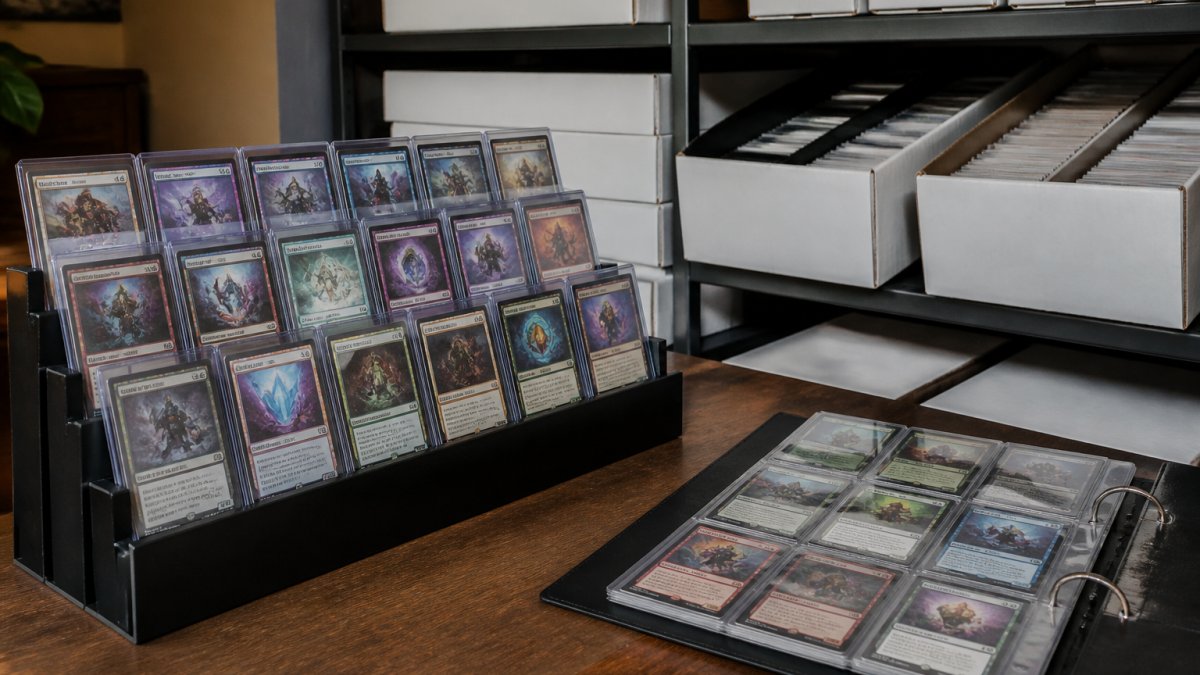
Binders, Boxes, and Display Shelves
Binders suit valuable or frequently used cards. They let you browse fast and keep cards flat. Use them for trades and set collection. A 3-inch binder with 100 pages holds about 900 cards.
Card boxes handle bulk. Four-row and five-row boxes are the standard for commons and uncommons. A four-row box holds roughly 3,000 unsleeved cards; a five-row box holds roughly 5,000.
Display shelves are for the cards you want to see. Our Trading Card Display Shelf - MTG, TCG, CCG, Graded Toploaders holds four cards across in four or five rows, so 16 or 20 cards sit visible at once. It is a self-standing tiered display, so it works on a desk or shelf.

A quick comparison:
| Storage Type | Best For | Capacity | Access Speed |
|---|---|---|---|
| Binder | Valuable or trade cards | 200-900 cards | Fast |
| Four-row box | Bulk commons | 3,000+ cards | Slow |
| Five-row box | Large bulk pools | 5,000+ cards | Slow |
| Tiered display shelf | Showcase cards | 16-20 per shelf | Instant |
Space Planning for a Massive Collection
Before you buy another box, measure your space. A five-row box is roughly 15 inches long, 12 inches wide, and 4 inches tall. Stacking them three high on a shelf means you need about 15 inches of shelf length and 12 inches of depth per stack.
A simple planning formula:
- Count your total cards.
- Divide by the capacity of your chosen box size.
- That is how many boxes you need.
- Multiply by the footprint of one box to get your shelf space.
If you have 30,000 cards and use five-row boxes, you need about six boxes. Stacked three high, that is two stacks. Two stacks fit on one sturdy shelf.
Leave 20 to 30 percent empty space on your shelves. Collections grow. If your shelves are full today, you have no room for tomorrow's purchases.
Trading Card Display Shelf – MTG, TCG, CCG, Graded Toploaders →
Future-Proofing Your Setup
- Buy one box size and stick with it. Mixed box sizes waste shelf space.
- Keep a labeled "overflow" box for new cards until you have time to sort them properly.
- Reserve one shelf for display only. Rotate cards through it instead of buying more storage.
- If you travel to events, keep a small portable box or binder separate from your long-term storage.
When to Upgrade Your Storage
You need more storage when:
- Boxes are stacked on the floor because shelves are full.
- You cannot find a card in under two minutes.
- New purchases sit unsorted for more than a month.
- Your display shelf is empty because boxes have taken over the desk.
At that point, add shelving or move to a larger box size. Do not buy more small boxes. They multiply clutter.
Build an MTG Collection Inventory Spreadsheet
An MTG collection inventory spreadsheet is a simple list of what you own, where it lives, and what it is worth. It sounds like homework. It saves hours later.
Start with these columns:
- Card name
- Set code
- Quantity
- Condition
- Storage location
- Estimated value
You do not need to log every common. Log rares, foils, and anything over a few dollars. Bulk can be tracked as a single line per box.
Update the sheet after each trade or purchase. Ten minutes a week beats a full weekend rebuild.
MTG Collection Management App: When to Go Digital
An MTG collection management app makes sense once your collection passes a few thousand cards. Below that, a spreadsheet is fine.
Apps help with:
- Scanning cards by camera
- Live price tracking
- Trade matching with other players
- Deck building from your own pool
The trade-off is time. Scanning thousands of bulk commons is not worth it. Scan your rares and playables, and leave bulk in boxes.
If you sell or trade often, an app pays for itself. If you mostly collect and display, a spreadsheet plus good shelving does the job.
Protecting Card Condition and Planning Long-Term Storage
Card condition decides value, so storage is really preservation. Keep these rules in mind.
- Store cards in a cool, dry room (Care, Handling and Storage of Works on Paper)
- Avoid basements and attics with humidity swings
- Use sleeves for anything worth more than a few dollars
- Keep top loaders for high-value singles
- Store boxes off the floor
For display, our Collapsible Trading Card Display Shelf | TCG MTG CCG holds over 45 cards in a 3x3 layout and packs flat for travel. It keeps your best cards visible without hiding them in a box.


Rotate displayed cards every few months. It limits light exposure and keeps the display fresh.
Conclusion: Keep Your System Simple and Consistent
The best system is the one you actually keep using. A two-phase sort, labeled boxes, a short spreadsheet, and a display shelf cover almost every collection.
Consistency matters more than perfection. Sort one box a week. Update the sheet after each trade. Rotate your display.
If you want your best cards out where you can see them, our Trading Card Display Shelf for Top Loaders holds up to 16 or 20 top-loaded cards in a clean grid. It is self-standing and built for collectors who want their cards accessible, not buried.
Get started with The Card Shelf Workshop and turn your collection into something you can actually enjoy.
Frequently Asked Questions
What is the best way to organize my Magic: The Gathering bulk collection?
Start by separating bulk from anything valuable. Sort bulk into commons, uncommons, and rares, then group by set or color depending on how you use them. Store bulk in four-row or five-row boxes with labeled dividers. Keep playable cards accessible in binders or a tiered display shelf. The goal is a system you can maintain as the collection grows, not a one-time perfect sort.
Should I sort MTG cards by set, color, or card type?
It depends on how you use the collection. If you build decks by set or draft, sort by set and collector number. If you brew casually, sorting by color and card type helps you find options fast. Most large collections end up using a hybrid: bulk by set, playables by color and type, and rares in binders or a display shelf. Pick one primary method and stick with it.
Is it worth cataloging a large MTG collection in a spreadsheet or app?
For collections over a few thousand cards, yes. An MTG collection inventory spreadsheet or a management app helps you avoid buying duplicates, track value, and find cards quickly. Start with your rares and cards worth over a few dollars, then expand. You do not need to catalog every common. Focus on the cards that actually affect deckbuilding or resale value.
How do you keep an MTG collection organized as it grows?
Set a rule for new cards the moment they enter your home: sort them into your existing system within a week. Keep empty boxes and dividers on hand so there is never an excuse to pile cards up. Do a quarterly review to move cards between bulk, trade, and display. A tiered, self-standing shelf for your best cards keeps the collection visible and reminds you to maintain it.