

Table of Contents
- How to Store Heavy Card Collections: Weight, Safety, and the Right Setup
- Trading Card Storage Boxes: Which Types Hold Up Under Real Weight
- How to Protect Trading Cards from Humidity and Heat Damage
- How to Organize a Card Collection So You Can Actually Find Cards
- Choosing a Graded Card Display Stand That Handles the Load
- Common Mistakes When Storing Heavy Card Collections
- Conclusion: Build a Storage System That Grows With Your Collection
- Frequently Asked Questions
Last Updated: October 12, 2026
How to Store Heavy Card Collections: Weight, Safety, and the Right Setup
A heavy card collection is any accumulation of cards, slabs, and boxes where total mass starts to affect how you store, move, and display it.
Below, we walk through box types, humidity control, organization, and display stands, plus the mistakes that quietly damage collections. The setup you build in an afternoon can outlast the cards themselves.
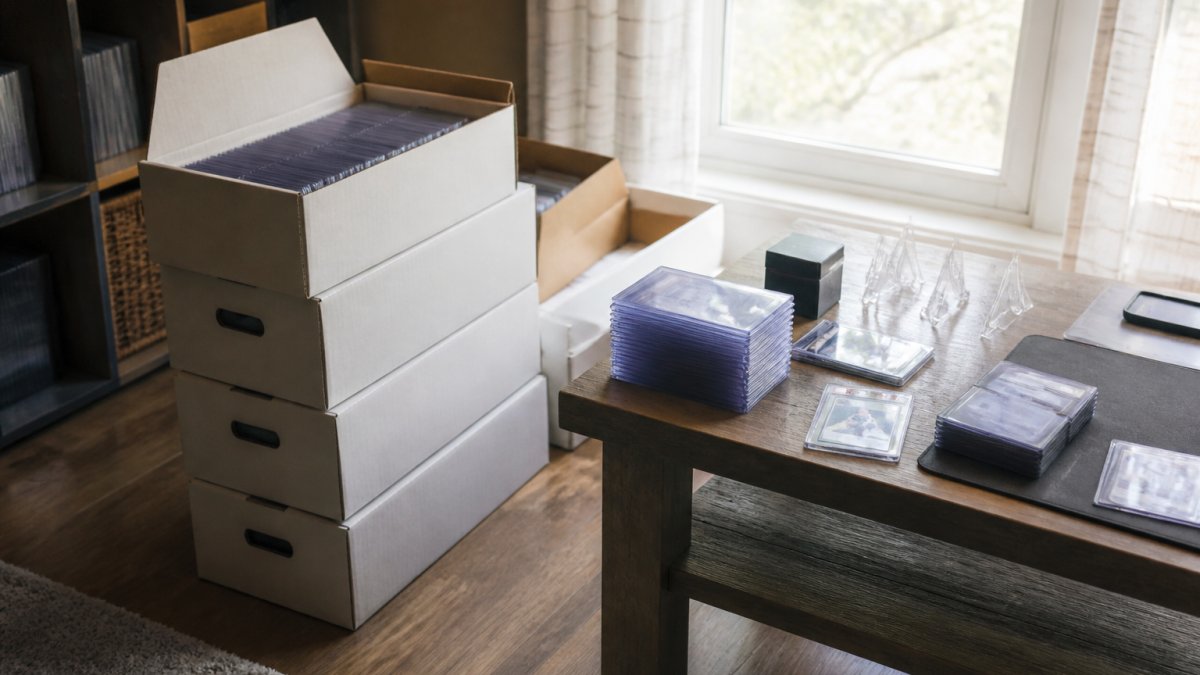
Trading Card Storage Boxes: Which Types Hold Up Under Real Weight
The best trading card storage boxes for heavy collections are rigid, double-walled, and sized so you can lift them without straining. Flimsy single-wall boxes crush under stacked slabs, and oversized boxes become impossible to move once full.

Here's how the common options compare:
| Box Type | Best For | Weight Handling | Watch Out For |
|---|---|---|---|
| Cardboard storage box (single-wall) | Raw cards, light loads | Weak when stacked deep | Crushes at the bottom of a stack |
| Double-wall corrugated box | Bulk raw cards, long-term | Holds up stacked | Still not moisture-proof |
| Plastic storage bin with lid | Slabs, mixed collections | Strong, stackable | Heavy once full; check lid fit |
| Cardboard "shoe" box | Small, sorted sets | Fine for light use | Corners split over time |
A common mistake is filling one giant box because it's convenient. Two medium boxes you can actually carry beat one monster box you can't.
How to Protect Trading Cards from Humidity and Heat Damage
To protect trading cards from humidity, keep them in a stable, dry space away from direct sun, radiators, and damp basements.
The mechanism matters more than the slogan. Card stock is paper fiber, and paper fiber expands and contracts as it absorbs and releases moisture.
A practical target range for most collections is 45-55% relative humidity and a temperature that stays between roughly 65°F and 72°F (18-22°C).
What actually works, in order of impact:
- Control the room, not the box. A small dehumidifier in a closed closet does more than a dozen silica packets scattered through bins. Silica gel saturates quickly and stops working silently; if you use it, check and recharge or replace it on a schedule.
- Keep boxes off concrete. Concrete floors and walls wick ground moisture and stay cold, which creates a local microclimate inside the bottom box of a stack. A simple wooden pallet or plastic riser breaks that contact.
- Block UV, not just sunlight. Direct sun fades card art, but so does prolonged indirect light through a window. UV-filtering film on a closet window or keeping storage in an interior closet solves both.
- Avoid attics, garages, and unfinished basements. These spaces swing the most in temperature and humidity. A stable interior closet beats a fluctuating garage every time, even if the garage feels drier on the day you check.
- Use archival-safe materials. Polypropylene sleeves and polyethylene bags are generally considered safe for long-term card storage; PVC pages and boxes with acidic adhesives are not. If a binder page smells like a new shower curtain, it is probably PVC and should not hold your best cards.
If you live somewhere humid, a simple room dehumidifier does more for your collection than any sleeve or box. For long-term preservation, consistency matters more than any single product: a stable closet beats a fluctuating garage every time.
How to Organize a Card Collection So You Can Actually Find Cards
The fastest way to organize a card collection is to sort by category first, then by set or value, and label everything before it goes back on the shelf.
But heavy collections add a second problem that lighter guides skip: access cost. Every time you unstack four boxes to reach the one at the bottom, you are lifting weight, stressing cardboard corners, and creating a chance to drop a slab.
Start with a simple system:
- Sort into keep, trade, and bulk piles.
- Group keeps by game, set, or sport.
- Pull your highest-value cards into slabs or top loaders.
- Label every box with contents and date.
- Log valuable cards in a spreadsheet or app.
Then layer on the weight-aware refinements:
- Tier by access frequency, not just value. Your most-viewed cards go on the self-standing tiered display or in the top box of a stack. Your long-term archive goes at the bottom, where you rarely need to reach it. This alone eliminates most of the lifting in a heavy collection.
- Cap box weight at what you can carry comfortably. A common pattern is to stop filling a box when it reaches roughly 20-25 pounds (9-11 kg). Two medium boxes you can actually carry beat one monster box you can't, and the bottom box in a stack never has to bear a crushing load.
- Label on the short end, not the top. When boxes are stacked, the short end is the only side you can read without unstacking everything. Use a consistent color code or numbering system so you can pull one box without disturbing the rest.
- Keep a simple inventory index. A spreadsheet with columns for box number, set, card range, and estimated value is enough. You do not need a full cataloging app unless your collection is large enough that insurance or resale matters. The index lives on your phone, not in the box.
- Reserve display space for rotation, not permanent storage. A self-standing tiered display is for cards you want to see. Treat it as a rotating showcase, not a filing cabinet. When a card comes off display, it goes back to its labeled box in the archive tier.
The goal is access without stress, on your back and on the cards. If finding one card means emptying four boxes, your system isn't working. Keep your most-viewed cards on a display stand and your bulk in labeled boxes, and you'll stop digging.
Modular Graded Card Display Shelf for PSA BGS CGC | Expandable 3x3 Slab Stand →

Choosing a Graded Card Display Stand That Handles the Load
A graded card display stand handles the load when it's built with real slab weight in mind, not just card count. Graded slabs are denser than raw cards, so a stand that looks full can be surprisingly heavy.

This is where a purpose-built stand beats a generic shelf. Our Modular Graded Card Display Shelf for PSA, BGS, and CGC slabs is a self-standing tiered display that holds nine slabs in a 3x3 layout and expands with additional units using heavy-duty alignment pins.
For a bigger showcase, the 4x4 Graded Card Display Stand holds up to sixteen slabs in a tilted grid with generous spacing, and it breaks into two pieces so it packs flat for card shows. If you mix raw cards and slabs, the Trading Card Display Shelf for MTG, TCG, and toploaders holds four cards across in four or five rows, with a wide option for thicker cases.
A few practical notes on weight and safety:
- Keep the heaviest, fullest stands on a stable, level surface
- Leave clearance around each stand so slabs aren't knocked when you reach in
- For renters or small spaces, our collapsible and stackable units let you build up rather than out
Common Mistakes When Storing Heavy Card Collections
The most common storage mistakes are overloading shelves, ignoring weight limits, and storing collections where temperature and humidity swing. Each one causes damage that's hard to reverse.
- Overloading a single shelf. Spread slabs across tiers instead of piling them in one spot.
- Ignoring weight limits. Any shelf, stand, or box has a practical limit. Respect it.
- Storing in damp or hot spaces. Basements, garages, and attics are the usual culprits.
- Skipping labels. Unlabeled boxes turn into mystery piles within a year.
- Displaying on unstable surfaces. A wobbly table is a tipped-over collection waiting to happen.
One more: don't assume a shelf that holds raw cards will hold slabs. Slabs are heavier and thicker, so check clearance and load before you commit. Our stands are built specifically for slab dimensions, which is why they hold up where a generic shelf sags.
Conclusion: Build a Storage System That Grows With Your Collection
The real challenge with heavy card collections isn't finding a box. It's building a system that stays safe and organized as the collection grows, without sagging shelves or lost cards.
That's what we build at The Card Shelf Workshop: modular, expandable display stands with tiered layouts, alignment-pin connections, and custom sizing so your setup grows with you.
Get started with The Card Shelf Workshop and build a display that holds your collection's weight, today and as it grows.
Frequently Asked Questions
How should you store a large trading card collection?
Split your collection by value and format. Keep high-value cards in rigid holders inside a storage box that stays flat, and move the rest into labeled boxes sorted by set or deck. For anything you want visible, a tiered display shelf keeps cards upright and accessible. The goal is separating long-term storage from display so heavy boxes are not stacked on top of each other and your best cards are not buried at the bottom of a pile.
How much weight can a trading card display shelf hold?
It depends on the shelf's material and how the load is spread. Tiered 3D-printed shelves made from PLA handle normal display loads of graded slabs and toploaders well because the weight sits across each tier rather than on a single point. If you are displaying dozens of thick slabs, spread them across multiple shelves instead of crowding one unit. Check the product listing for slot thickness limits so slabs fit without forcing.
How do you keep card storage boxes from bending or collapsing?
Never stack full boxes more than two high, and avoid storing them on a wire rack where the base can bow. Use boxes with rigid walls rather than soft cardboard, and fill empty space with bubble wrap or foam so the cards cannot shift. If a box feels soft when you lift it, that is a sign the contents are too heavy for the material. Rotate stored boxes periodically and keep them on a flat, solid surface.
How do you protect trading cards from humidity and heat?
Keep cards away from basements, attics, and exterior walls where moisture and temperature swings are worst. Store boxes in an interior closet or on a shelf in a room with stable conditions. Add silica gel packets to storage boxes and replace them every few months. Never leave cards in a car or near a radiator. For graded slabs, the case itself adds some protection, but the surrounding environment still matters for the long term.
Should valuable trading cards be stored in binders or boxes?
Boxes win for anything valuable. Binders look great but pages can press against card surfaces and cause wear over years, especially if the binder is stored upright. Use a box with rigid dividers for cards worth protecting, and reserve binders for trade stock or cheaper sets you flip through often. If you want cards visible, use a graded card display stand instead of a binder page so nothing presses on the card face.
How should graded cards be stored and displayed?
Graded slabs are heavy and thick, so they need a stand built for that format. A modular graded card display shelf with slots sized for PSA, BGS, or CGC slabs keeps them upright and fully visible without stacking pressure. Keep the display out of direct sunlight to slow label fading, and avoid spots near heating vents. If you are not displaying a slab, store it flat in a padded box rather than leaning it against a wall.