

Table of Contents
- 3D Printed vs Acrylic Display Stands: A Quick Comparison
- How We Evaluated These Display Stands
- Material Durability, UV Exposure, and Long-Term Aging
- Graded Card Display Stand Options
- Adjustable Trading Card Stand Designs
- Trading Card Slab Holder: Fit and Compatibility
- Display Stands for Sports Cards: Choosing by Use Case
- Frequently Asked Questions
Last Updated: October 5, 2026
3D Printed vs Acrylic Display Stands: A Quick Comparison
If you have ever watched a prized card sit in a storage box instead of on a shelf, you already know the problem. The choice between 3D printed vs acrylic display stands for trading cards comes down to a simple trade-off: acrylic offers optical clarity and a uniform factory finish, while 3D printed stands offer custom fit, thicker card support, and colors you can actually choose. This guide from The Card Shelf Workshop breaks down material durability, slab compatibility, and cost so you can pick the right display stands for your collection.
Here is the short version. Acrylic looks glassy and comes in fixed sizes. 3D printed stands are built to order, so they can be sized around thick slabs, top loaders, and one-touch magnetic cases that generic acrylic racks simply do not accommodate.
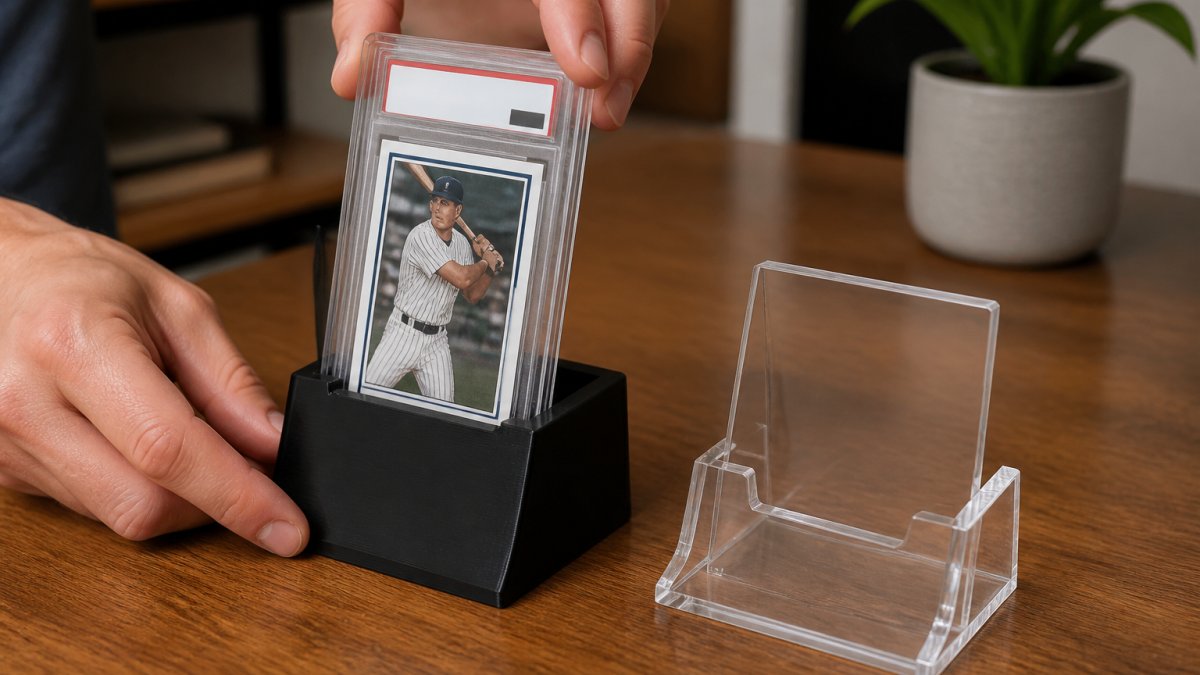
| Factor | 3D Printed (PLA) | Acrylic |
|---|---|---|
| Custom sizing | Made to order, any width or row count | Fixed stock dimensions |
| Thick slab fit | Slots up to 13mm on graded models | Limited, often standard only |
| Finish | Matte, layer lines visible up close | Glossy, uniform, transparent |
| Color options | Black, white, or custom colors | Usually clear only |
| Repairability | Individual parts can be reprinted | Cracks often mean replacement |
| Weight | Light, easy to stack | Heavier, more brittle |
| Best for | Odd sizes, thick cases, custom colors | Buyers who want clear, off-the-shelf |
How We Evaluated These Display Stands
We judged every stand on five things: card support and stability, fit across case types, material aging, color and personalization options, and total cost. That framework matters because a stand that looks great but lets a slab slide forward is worse than a plain one that holds it steady.
Three checks drove our scoring:
- Stability: Does the stand resist tipping when you remove the front card?
- Fit: Does it hold standard card sleeves, top loaders, and thick slabs without wobble?
- Safety: Does the contact surface protect card edges rather than press on them?
What most guides miss is that stability is a design question, not a material question. A well-angled 3D printed stand with retention tabs can hold a 75pt card in place better than a flat acrylic groove that lets it lean.
Material Durability, UV Exposure, and Long-Term Aging
Most display stand comparisons stop at "acrylic is clear, PLA is matte." That leaves out the part that actually matters over years of ownership: how each material responds to light, heat, scratches, and handling. Here is the honest, mechanism-level breakdown.
Acrylic (PMMA) is a rigid, transparent thermoplastic. It resists yellowing better than many plastics when kept out of direct sun, and it does not become brittle overnight. But it has two real weaknesses.
PLA, the filament used in most 3D printed stands, is rigid and holds its shape well indoors. Its main vulnerability is heat.
UV exposure is the bigger long-term risk to your cards, not the stand. Both acrylic and PLA can degrade under prolonged direct sunlight, but the card art, autograph, and grade label will fade or discolor before the stand becomes unusable.
Conservation and contact points matter more than material choice for card safety. Both materials are safe for standard card storage as long as the card stays in a sleeve, top loader, or slab.
A common pattern is that collectors replace acrylic stands after a drop or a scratch, while 3D printed stands are replaced when a slot warps or a design changes.
Graded Card Display Stand Options
A graded card display stand has one job: hold a heavy slab at a readable angle without covering the label or the card art. This is where 3D printed designs pull ahead, because slab dimensions vary by grading company and a fixed acrylic rack rarely accounts for that.
Our graded card display shelf for PSA, BGS, and CGC slabs holds 16 graded slabs in a 4x4 grid. The slots accept cases up to 13mm thick, which covers thick memorabilia slabs and heavy-duty holders, and the 125mm vertical spacing per tier keeps each row visible. It ships as two pieces that slide together with no tools.
The one thing to know: because BGS, PSA, and SGC use different case heights, a small overlap occurs at the bottom edge of each tier. That overlap usually falls within the clear border of the slab, so the artwork and grade label stay visible.
Adjustable Trading Card Stand Designs
An adjustable trading card stand is any design that lets you change capacity, angle, or layout instead of locking you into one fixed size. In practice, there are three approaches, and they are not equal.

1. Fixed-angle, fixed-capacity stands. These are the simplest and cheapest. They hold a set number of cards at one angle. They work if your collection never changes, but they become waste the moment you outgrow them or switch case types.
2. Modular stands. These are the practical version of "adjustable." You expand by adding units rather than buying a whole new rack.
Trading Card Display Shelf – MTG, TCG, CCG, Graded Toploaders →
3. Collapsible or packable stands. These break down flat for transport and reassemble in seconds. They are the right choice for tournament players, trade nights, and anyone who displays cards in more than one location.
Our collapsible trading card display shelf breaks down flat for transport and holds over 45 cards in a 3x3 layout or over 60 in a 3x4. It assembles in seconds, which makes it the one we would take to a tournament or a trade night.
What to check before buying an adjustable design:
- Capacity per unit: How many cards does one unit hold, and how many units can you realistically fit on your shelf?
- Assembly: Does it need tools, or does it slide together? Tool-free assembly matters if you rearrange often.
- Storage footprint when collapsed: If you pack it away, how much space does it take?
- Case compatibility: Does the adjustable design accept the case types you actually own, sleeves, top loaders, 35pt to 75pt holders, 180pt cases, or graded slabs?
- Stability when expanded: A modular unit that wobbles when you remove the front card is worse than a fixed stand that stays put.
A common pattern is that collectors buy a fixed acrylic rack first, outgrow it, then switch to a modular 3D printed system. The fixed rack becomes a sunk cost.
Trading Card Slab Holder: Fit and Compatibility
Fit is where most display stands quietly fail. A trading card slab holder needs to match your actual case thickness, not an average. Standard top loaders, 35pt and 75pt holders, and 180pt cases all sit at different depths, and a slot sized for one will rock or bind on another.
Here is how the common cases break down:
| Card Holder Type | Typical Thickness | Notes |
|---|---|---|
| Standard card sleeve | Under 1mm | Fits almost any stand |
| Standard top loader | 3" x 4" rigid | Needs a dedicated channel width |
| 35pt to 75pt hard case | Up to 8.75mm | Fits wide-slot 3D printed models |
| 180pt case | Around 11mm | Needs a wider custom slot |
| Graded slab (PSA, BGS, CGC) | Up to 13mm | Requires a graded-specific stand |
Our trading card display shelf for MTG, TCG, and graded top loaders is built around this. The 4x4TW and 4x5TW options take cards in hard cases up to 8.75mm, and 180pt cases need a wider slot that we adjust before production. That is the advantage of made-to-order: the stand is sized to your cards, not the other way around.

If you are unsure which thickness you own, measure the case with digital calipers before ordering. It takes ten seconds and prevents a return you cannot make on a custom item.
Display Stands for Sports Cards: Choosing by Use Case
Display stands for sports cards follow the same rules as TCG and Pokémon setups, with one difference: sports collectors often hold thick patch and autograph slabs that push past standard slot depths. Match the stand to the case, not the sport.
A quick way to decide:
- Graded slabs on a desk: choose a graded-specific grid stand with 13mm slots.
- Raw cards in top loaders: choose a top loader grid with standard or "T" channel widths.
- A portable tournament setup: choose a collapsible, packable design.
- A mixed collection of decks and slabs: choose modular units you can stack and rearrange.
Our top loader display shelf covers the raw-card case with 4x4 and 4x5 grid options, and the "T" version widens the channels for thicker cases up to 9mm. For smaller displays, the Card Display Shelf holds 35pt and 75pt cards with retention tabs that keep them in place even when you move your shelf. Every shelf we make is a self-standing tiered display, so it sits on a desk or shelf without any mounting.

Choosing the right display stand comes down to one question: do you want a fixed rack that fits average cards, or a stand built around the exact cases you own? Acrylic gives you clarity and a stock size. The Card Shelf Workshop gives you made-to-order fit, modular designs that grow with your collection, and custom colors to match your setup. Our shelves are 3D printed from PLA, rated 4.9 from 100 reviews, and built by collectors who got tired of watching good cards sit in boxes. Explore the range and give your collection the display it has earned.
Frequently Asked Questions
Are 3D-printed or acrylic stands better for displaying trading cards?
It depends on your priorities. 3D-printed stands offer more customization, better fit for specific card thicknesses, and a wider range of color options. Acrylic stands provide a uniform, glass-like look. For collectors with graded slabs or unusual card sizes, 3D-printed stands typically fit better because they can be made to order. For a simple, uniform display of standard cards, acrylic works well. Consider your card types, display space, and whether you want to customize before deciding.
Are 3D-printed stands stable enough for graded cards?
Yes, when designed with the right wall thickness and base dimensions. A well-made 3D-printed display stand for graded cards uses high-density walls and a wide base to prevent tipping. Look for stands specifically engineered for slab thickness, such as those with 13mm slot clearance for thick cases. The key is matching the stand's slot width and base footprint to the weight and size of your slabs.
Can acrylic stands scratch or damage trading cards?
Acrylic can develop scratches over time, and those rough edges may contact card surfaces if the fit is loose. 3D-printed stands made from PLA have a slightly textured surface that holds cards more securely with less sliding. Both materials can be safe if the stand is designed with smooth, card-safe channels. Always check that the stand does not grip the card too tightly or leave marks on the surface.
How do I keep trading cards safe while displaying them?
Use protective holders such as top loaders, one-touch magnetic cases, or graded slabs before placing cards in any display stand. Keep displays out of direct sunlight to prevent UV fading, and avoid areas with high humidity or temperature swings. Dust regularly with a soft brush. For high-value cards, consider a stand with retention tabs that hold the card securely even if the display is bumped.
Can a trading card display stand fit different card sizes?
Many stands are designed for standard 3" x 4" top loaders or specific slab dimensions. Some 3D-printed stands offer adjustable or modular designs that accommodate different card thicknesses, from 35pt to 180pt cases. If you collect both raw cards and graded slabs, look for a stand with wide channels or a modular system that lets you change shelf spacing. Always verify the slot width matches your thickest case.