

Table of Contents
- How to Display Graded Trading Card Slabs Without Visual Chaos
- Choose the Right Graded Card Display Stand for Your Collection
- PSA Slab Display Ideas: Arrangement Strategies That Work
- Using a Trading Card Slab Organizer to Reduce Clutter
- How to Display PSA Slabs with Proper Spacing and Alignment
- Curate Your Display: Rotation and Selective Showcase
- Lighting and Protection for Long-Term Display
- Conclusion
- Frequently Asked Questions
Last Updated: October 18, 2026
How to Display Graded Trading Card Slabs Without Visual Chaos
The difference between a stunning collection and a cluttered mess comes down to intentional spacing and smart arrangement. When graded trading card slabs sit too close together, they blur into a wall of plastic, and with the wrong lighting or mismatched sizes, your prized cards start looking like storage.
At The Card Shelf Workshop, we've helped hundreds of collectors solve this exact problem. The solution requires understanding a few core principles about how slabs display best.
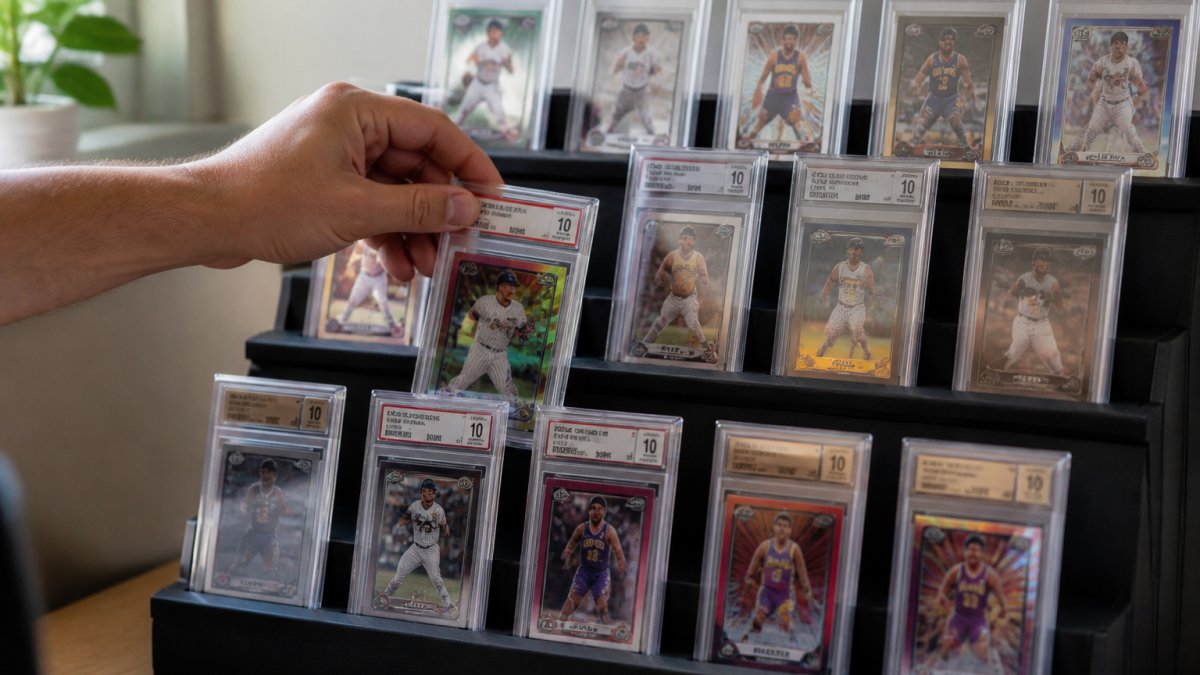
Treat your display like a gallery, not a storage unit: choose the right stand, space your slabs deliberately, and curate what you show.
Choose the Right Graded Card Display Stand for Your Collection
Not all display solutions work the same way. Your choice depends on your collection size, the types of slabs you own, and the space you have available.
Tiered Stands vs. Linear Shelves
A tiered stand creates visual depth and reduces clutter by stacking cards vertically.
A linear shelf displays cards in rows. It feels more organized and formal, but takes up more horizontal room.
If you're working with a small desk or shelf, go tiered; if you have a long surface, linear gives you flexibility to add cards over time.
Our Graded Card Display Shelf for PSA BGS CGC Slabs holds up to 16 cards in a 4x4 grid with tiered spacing.

Capacity and Space Planning
Before you buy, count your slabs and add 20% for future purchases so your shelf never looks crowded.
A typical graded slab takes up about 3 inches of horizontal space. A tiered stand with 16-card capacity needs roughly 12 inches of width and 10 inches of depth. Check your available space before ordering.
If your collection is smaller, start modest and expand later with modular pieces, that beats buying a huge stand and leaving it half-empty.
PSA Slab Display Ideas: Arrangement Strategies That Work
How you arrange your slabs matters as much as where you put them. The right layout looks intentional and curated; the wrong one makes even a small collection feel crowded. Here's the practical layout planning that prevents clutter on a self-standing tiered display.
Start With a Layout Plan, Not a Purchase
Before placing a single slab, measure your display and sketch a simple plan. A self-standing tiered display sits on a desk, shelf, or table, so you're working with a fixed footprint, measure its width and depth, then note how many slots each tier holds.
A common pattern is to plan for 70-80% occupancy. If your shelf holds 16 slabs, aim to display 11-13 at a time. The empty slots act as visual breathing room and give you space to rotate cards without rearranging everything.
The Grid Layout Method (With Real Spacing)
The grid method is simple: arrange slabs in even rows and columns.
A 4x4 grid (16 slabs) looks full without feeling cramped. A 3x3 grid (9 slabs) looks curated and intentional.
Spacing is where most displays fail. Leave at least half an inch between slabs and a full inch between rows.
Place your highest-value or favorite cards in the center of the grid, or on the middle tier of a tiered stand.
Creating Visual Hierarchy
Visual hierarchy means deciding what the eye sees first, second, and third. Without it, every slab competes for attention and the result feels cluttered even when spacing is generous.
A simple hierarchy for a tiered display:
- Top tier or center: your 2-3 anchor cards, highest grade, favorite player, or rarest slab.
- Middle tiers: supporting cards grouped by theme, set, or team.
- Outer edges: lower-priority cards or duplicates.
Group by theme, player, or grade rather than mixing randomly, cohesive groupings look curated and show you've thought about the display.
Example Layouts for Small and Large Collections
Small collection (9 slabs or fewer): Use a 3x3 grid on a single self-standing tiered display.
Medium collection (10-20 slabs): Use a 4x4 grid or a modular tiered display. Display 12-14 cards, grouped into two or three themes across tiers. Rotate the outer cards quarterly while keeping the center anchors fixed.
Large collection (20+ slabs): Use multiple self-standing tiered displays rather than cramming one unit.
Mixing Slab Sizes Without Visual Disorder
PSA, BGS, and CGC slabs aren't identical in size, and mixing them is a common source of visual clutter. PSA slabs measure about 2.5 inches wide and 3.5 inches tall, BGS slabs run slightly thicker, and CGC slabs vary by thickness.
A practical approach is to keep each tier or row to one grading company where possible. If you must mix, place the thicker slabs on the lower tiers and the thinner ones above, so the display steps back naturally.
Using a Trading Card Slab Organizer to Reduce Clutter
An organizer isn't just a stand, it's a system that makes curation automatic.
Sort your slabs into categories, grade, player, sport, or set, and decide which deserve display versus storage.
Graded Card Display Shelf for PSA BGS CGC Slabs | Collectible Trading Card Stand →
Rotate quarterly: swap out cards you've shown for months so the display stays fresh without overwhelming any single shelf.
Our Modular Graded Card Display Shelf for PSA BGS CGC works as an organizer because it's expandable. Start with a 3x3 base (9 cards).

How to Display PSA Slabs with Proper Spacing and Alignment
PSA, BGS, and CGC slabs all have different dimensions, which creates alignment challenges.
Spacing Standards for Different Slab Types
PSA slabs measure about 2.5 inches wide and 3.5 inches tall, BGS slabs run slightly thicker, and CGC slabs vary by thickness, account for these differences when mixing companies.
Our Graded Card Display Shelf accommodates slabs up to 13mm thick. This covers standard PSA, thicker BGS cases, and heavy-duty memorabilia slabs.
With one grading company, alignment is straightforward. When mixing companies, accept that tops and bottoms won't align perfectly, that's normal and doesn't hurt the display.
Angled Viewing for Minimal Glare
A flat shelf creates glare, light bounces off the plastic straight into your eyes. An angled shelf tilts cards forward so light scatters away.
The angle doesn't need to be steep, just 10 to 15 degrees is enough. This keeps cards visible and glare-free.
Our tiered stands are designed with this angle built in. Cards sit forward naturally, so you see the artwork and grading label clearly without squinting.
Curate Your Display: Rotation and Selective Showcase
The best displays aren't the biggest, they're the most thoughtful.
Choose your top 9 to 16 cards as anchor pieces and display them consistently, rotating secondary cards every few months.
Ask yourself: Why does this card deserve to be shown? Is it your favorite player? Your best grade? Your rarest find?
Curation creates a story: a random assortment is just storage, while a curated display tells people who you are as a collector.
Lighting and Protection for Long-Term Display
Proper lighting makes your display look professional and protects your cards. Here's how to handle placement, glare, and preservation on a self-standing tiered display.
Lighting Placement That Reduces Glare
Glare is one of the biggest reasons a display looks cluttered, light bouncing off slab plastic washes out details and creates hot spots that pull the eye away.
Light from above and slightly in front, never directly in front or from the side.
If your display sits near a window, position it so sunlight falls across the slabs at an angle rather than directly onto the faces.
UV Protection and Sunlight
UV exposure fades card colors over time, and no display method reverses that damage (Limiting Light Damage). Keep your self-standing display out of direct sunlight; if the room gets strong natural light, move it to a spot with indirect light or use UV-blocking window film or a UV-filtering cover.
Rotating which cards sit in the brightest positions limits cumulative exposure on any single slab, pair this with the rotation strategy covered earlier.
Room Safety and Long-Term Preservation Checklist
A practical checklist for keeping a tiered display safe over the long term:
- Keep it cool and dry. Avoid heat sources such as radiators, space heaters, and direct sun. Extreme heat and humidity can warp slab plastic and damage cards over time.
- Control humidity. A stable, moderate indoor environment is ideal. Avoid placing the display in basements or bathrooms where humidity swings are common.
- Stabilize the stand. Because your shelf is self-standing rather than wall-mounted, place it on a level, stable surface away from foot traffic and edges where it could be knocked. Avoid stacking heavy items against it.
- Dust gently. Dust builds up on slabs over time. Wipe the display and slabs gently with a microfiber cloth every month. Do not use water or chemicals, a dry cloth is enough.
- Check for movement. Periodically confirm that slabs sit securely in their slots and that the stand itself has not shifted. A stable display protects both the cards and the look of the arrangement.
Conclusion
Displaying graded trading card slabs without clutter comes down to three things: the right stand, intentional spacing, and thoughtful curation.
Our Modular Graded Card Display Shelf for PSA BGS CGC lets you start small and expand as your collection grows.
Start with a 3x3 base, display your best 9 cards, and enjoy a clean, intentional showcase. Your collection deserves to be seen, not buried.
| Approach | Best For | Result |
|---|---|---|
| Grid layout | Organized, formal displays | Clean, professional look |
| Tiered stand | Small spaces, multiple cards | Maximum visibility in minimal footprint |
| Rotation strategy | Keeping display fresh | Enjoy entire collection over time |
| Modular system | Growing collections | Scale up without replacing |
Frequently Asked Questions
How do I display graded cards to avoid a cluttered appearance?
Start with a dedicated graded card display stand that enforces consistent spacing and alignment. Arrange slabs in a grid pattern (like 4x4 or 3x3) rather than randomly stacking them. Leave breathing room between cards by using a stand with proper vertical shelf spacing, at least 125mm between tiers helps prevent visual crowding. Display only your best or most meaningful slabs; rotate others seasonally. A tiered stand naturally organizes PSA, BGS, and CGC slabs at different heights, which makes each card feel intentional rather than packed.
What should I look for in a graded card display stand?
Look for stands that accommodate your slab thickness (standard PSA slabs need 10mm clearance, thicker BGS cases need 13mm), offer consistent spacing between slots, and feature an angled design to minimize glare. Self-standing tiered displays work best because they let you arrange cards at multiple heights, reducing the flat, cramped look of single-level shelving. Ensure your stand fits your collection size, a 4x4 stand holds 16 cards comfortably without overwhelming a room, while a modular 3x3 stand gives you flexibility to expand later by stacking additional units.
How many graded cards should I display at once?
Display only cards that deserve showcase status: your highest-graded slabs, favorite players, or meaningful pulls. Most collectors find 9 to 16 cards per display creates impact without clutter. If your collection is larger, rotate seasonal displays or use multiple smaller stands in different rooms. A trading card slab organizer with modular capacity lets you start small (9 cards on a 3x3 unit) and expand only when you've truly earned more showcase space. This approach keeps each card feeling special rather than lost in a sea of plastic.
Can I display different slab types together without it looking messy?
Yes, but group by size and grading company when possible. PSA, BGS, and CGC slabs have slightly different dimensions, so mixing them in the same row can create uneven sight lines. A tiered stand with proper shelf spacing accommodates all slab types, but arranging PSA slabs together on one tier and thicker BGS cases on another creates visual harmony. If you mix types, place thicker cases at the bottom and standard slabs above to avoid a haphazard appearance. The key is intentional placement, any arrangement looks organized if cards are evenly spaced and aligned.