

Table of Contents
- Modular Display Systems for MTG Collections: What Changed in 2026
- How to Display MTG Cards Safely Without Risking Damage
- Graded Card Display Stand Options: Slabs vs. Raw Cards
- Expandable Trading Card Display: Building Your Collection Over Time
- Capacity, Weight, and Stability: What Your Shelves Need to Handle
- Organizing Large Collections: Sorting, Categorization, and Modular Planning
- Choosing the Right System for Your Space and Collection Type
- Frequently Asked Questions
Last Updated: October 17, 2026
Modular Display Systems for MTG Collections: What Changed in 2026
Five years ago, most collectors stored cards in binders or bulk boxes. Today, display-focused systems dominate, and modular display systems MTG have become the standard for serious collectors.
Two things changed: PSA and CGC made slabs thinner and more consistent, enabling precision-engineered displays, and collectors realized hiding cards defeats the point of collecting. Your cards deserve to be seen.
A system that grows with your collection beats one that forces you to buy new shelving when you outgrow it.
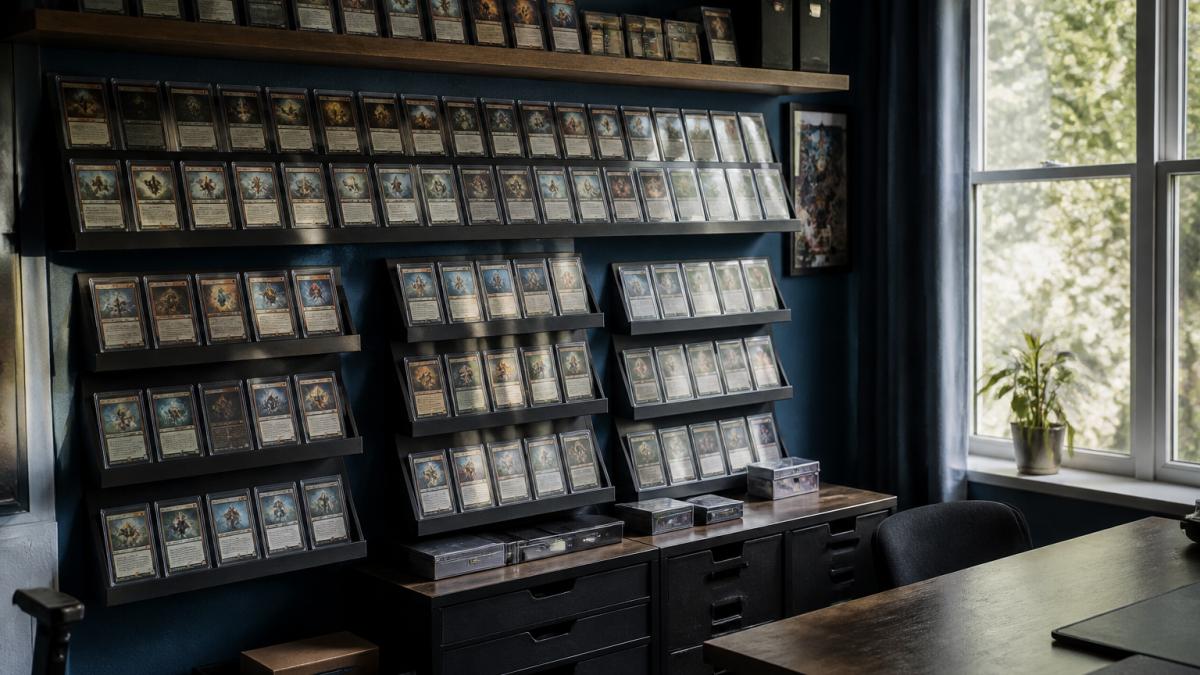
Below, we'll cover the best modular display systems in 2026 and how to choose the right one for your situation.
How to Display MTG Cards Safely Without Risking Damage
The biggest mistake collectors make is prioritizing looks over protection. A beautiful display means nothing if your cards warp, fade, or get damaged.
Safe MTG card display starts with your storage environment. Temperature fluctuations, humidity, and direct sunlight are the three killers; the right shelf minimizes exposure.

Your cards need airflow, consistent conditions, and dust protection. Closed cases trap humidity; open shelving breathes better. Your shelf should hold cards at a 30-45 degree angle so gravity works with you.
For graded slabs, angle is even more critical. A slab sitting flat puts all the weight on the bottom edge; angled display distributes pressure evenly across the base.
Never display cards in direct sunlight, which fades ink, weakens cardstock, and damages protective coatings. A north-facing wall or interior room works best; near a window, use UV-filtering glass or keep cards at least six feet away.
Graded Card Display Stand Options: Slabs vs. Raw Cards
Not all display systems work for both graded slabs and raw cards, and many collectors mix both.
Graded slabs (PSA, BGS, CGC) are rigid, uniform cases. They're built to last and designed for display. A slab display system needs precision-engineered slots that fit the exact thickness of the case, typically 10mm for standard slabs, up to 13mm for heavy-duty cases with thick guards. The PSA official slab specifications confirm these dimensions have remained consistent since 2024.
Raw cards in toploaders or hard cases are more variable: a toploader might be 35pt (0.035 inches) or 75pt (0.075 inches) thick, and one-touch magnetic holders add another dimension. A raw-card system needs wider, more flexible slots.
The Card Shelf Workshop makes separate systems for each: graded card display stands with precision slots engineered for slab thickness, and raw card shelves with wider channels for multiple case types.

If you collect both types, you have three options: buy two separate systems, choose one designed for your primary card type and accept imperfect fit for the secondary, or display slabs on one shelf and raw cards on another.
The best choice depends on your collection ratio. If you're 80% slabs and 20% raw, buy a slab-focused system. If you're mixed 50/50, buy two systems and stack them together.
Expandable Trading Card Display: Building Your Collection Over Time
Your collection will grow, and you'll outgrow your first display system. The question is whether your shelf grows with you or becomes obsolete.
Modular display systems MTG solve this with alignment pins, connectors, or stacking methods that let you add shelves over time. Instead of a massive 4x4 grid, start with a 3x3 unit and add expansion packs later.
The Card Shelf Workshop's modular graded card display shelf uses heavy-duty alignment pins to lock multiple units together. You can start with a single 3x3 shelf (holds 9 cards) and expand to a 6x3 tower (18 cards) by adding a second 3x3 unit with pins included. The pins ensure perfect alignment so shelves sit flush and level.
This approach spreads the cost over time, buys only the capacity you need, and lets you reconfigure as your collection changes. If you move, break the system apart and rebuild it in a new space.
Collapsible systems offer another expandable option: a frame design you can stack side-by-side or vertically. A 3x3 collapsible shelf holds over 45 cards (five stacked per position); add a second unit and you've doubled your display.
The trade-off: collapsible systems are more portable and pack flatter. For frequent moves or conventions, go collapsible; for a permanent display, go modular with pins.
Capacity, Weight, and Stability: What Your Shelves Need to Handle
Most collectors worry: "Will these shelves hold my collection without sagging or breaking?"
The answer depends on slab weight, shelf material, and support design.
A single graded slab weighs 2-4 ounces, so a 4x4 grid (16 cards) weighs roughly 3-5 pounds. The real weight comes from stacking shelves vertically.
Modular Graded Card Display Shelf for PSA BGS CGC | Expandable 3x3 Slab Stand →
A 3x3 modular shelf holds 9 slabs; stack three vertically and you're at 10-15 pounds distributed across the alignment pins and base. That's manageable for a well-engineered 3D-printed system, but the design matters.
The Card Shelf Workshop uses high-density PLA filament for structural parts. The alignment pins handle vertical stacking without bending, and our graded card display shelf for PSA BGS CGC slabs uses a two-piece design with a heavy-duty base that absorbs stacked weight.

For raw cards in toploaders, weight is slightly higher per card but density is lower. A 4x5 grid (20 cards) weighs roughly 4-6 pounds.
Stability depends on the base. Our modular systems use a footprint-to-height ratio that prevents tipping even when fully loaded.
Since all of our shelves are self-standing tiered displays, they rely on base stability and internal bracing rather than wall mounting. This is more flexible because you can move your shelf without drilling into walls.
| System Type | Capacity | Weight Per Shelf | Stability Rating |
|---|---|---|---|
| 3x3 Modular Graded | 9 slabs | 3-5 lbs | Excellent |
| 4x4 Graded | 16 slabs | 6-8 lbs | Very Good |
| 4x5 Toploader | 20 toploaders | 5-7 lbs | Very Good |
| Collapsible 3x3 | 45 cards (stacked) | 8-10 lbs | Good |
Organizing Large Collections: Sorting, Categorization, and Modular Planning
With a massive MTG collection, display is only half the problem; organization is the other half.
Most collectors sort by set, then color, then card type. This creates visual cohesion and makes specific cards easier to find.
Use your display shelf for favorite, most valuable, or actively played cards, and bulk storage for everything else. Your display should be the highlight reel, not your entire collection.
For a massive collection, modular systems shine because you can dedicate separate shelves to categories: graded, raw, foils, special editions. This visual separation makes the display feel intentional rather than random.
The Card Shelf Workshop's collapsible trading card display shelf works well for this because you can configure it as a 2x3 (2 columns, 3 rows) or 3x3 or 3x4 depending on how many cards you want to display. You can also stack multiple units to create a larger wall without committing to a single massive system.
One practical tip: label your display. Use small cards or printed labels to identify each shelf's category (e.g., "Alpha Set," "Graded Rares," "Foil Collection"). This sounds obvious, but it transforms your display from a beautiful mess into a curated gallery.
Choosing the Right System for Your Space and Collection Type
The best modular display system depends on three things: your collection type, your available space, and your budget.
For graded card collectors, the modular graded card display shelf for PSA BGS CGC slabs is built exactly for you. It holds standard slabs securely, uses alignment pins for easy expansion, and costs $36.99 for a 3x3 unit. If you collect sports cards, Pokémon, or MTG slabs, this is your system. The precision-engineered slots fit PSA, BGS, CGC, and SGC cases without any wobble.
For raw card collectors using toploaders, the trading card display shelf for top loaders is engineered for standard 3x4 rigid sleeves. It comes in 4x4 (16 cards) or 4x5 (20 cards) configurations and costs $44.99. The high-density grid layout maximizes wall space and keeps cards visible from top to bottom.
For mixed collectors (both slabs and raw cards), buy two systems. The trading card display shelf for MTG, TCG, CCG, graded toploaders is versatile enough to hold both types, though it's optimized for toploaders. It costs $39.99 and accommodates 4 cards across in 4-5 rows.
For collectors on a budget, the trading card display shelf: wall mount or desk stand offers flexibility at $7.99 per unit. It holds 1-4 cards and works for both wall and desk display. You can buy multiple units and stack them to build a larger display over time. It's not as elegant as a unified modular system, but it's affordable and functional.
For travelers or convention-goers, the collapsible trading card display shelf is your answer. It costs $27.99, packs flat for transport, and assembles in seconds. It holds 45-60 cards depending on configuration and is perfect for showcasing your collection at tournaments or trade shows.
The decision tree is simple: ask yourself three questions. First, what type of cards do I primarily collect? Second, how much space do I have? Third, how much am I willing to spend?
From there, the right system becomes obvious. Your shelf should match your collection, not the other way around.
Displaying your MTG collection shouldn't feel like a compromise between beauty and protection. The modular display systems available in 2026 solve both problems. Whether you're showcasing graded slabs, raw toploaders, or a mix of both, The Card Shelf Workshop has engineered solutions that grow with your collection and protect your cards.
Frequently Asked Questions
What is the best way to display a Magic: The Gathering card collection?
The best approach depends on your collection size and card condition. For graded slabs, use a dedicated graded card display stand that holds them at an angle for visibility and protection. For raw cards in top loaders, choose a modular display system that lets you arrange cards in a grid layout. Self-standing tiered shelves work well because they don't require wall mounting and can be positioned anywhere in your space. Start with a single unit and expand as your collection grows.
Can modular displays hold the weight of a massive MTG collection across multiple storage boxes?
Yes, modular display systems are engineered for durability. Each shelf unit is precision 3D-printed with high-density walls designed to support the weight of graded slabs and hard cases. If your collection spans multiple boxes, you can stack or connect several modular units together using alignment pins. This approach distributes weight across multiple shelves rather than overloading a single unit. Always verify the shelf's specifications match your card protection method (standard slabs, thick cases, or raw cards).
How do I expand a card display as my collection grows?
Expandable modular systems let you add shelves without replacing your entire setup. Order a baseline unit first, then purchase expansion packs with alignment pins to connect additional shelves vertically or horizontally. For example, start with a 3x3 shelf holding 9 cards, then add a 3x2 expansion pack to create a 6-card tier above it. This modular approach means you only buy what you need now and scale up later without waste or downtime.
What should I look for in a modular card display system for MTG cards?
Prioritize universal compatibility with your card protection method (standard PSA slabs, BGS cases, top loaders, or raw cards). Check the slot thickness specifications to ensure your cases fit without forcing. Look for systems with alignment pins or connection points so you can expand easily. Consider visibility, shelves with minimal obstruction let you see card art and grading labels. Finally, verify the material is durable PLA plastic and inspect customer reviews for real-world weight-holding performance with large collections.