

Table of Contents
- Why Tiered Shelves Beat Flat Storage for Oracle Decks
- Tarot Deck Storage Ideas That Actually Work in Small Spaces
- Sizing Your Tiered Shelf: Deck Thickness, Width, and Row Count
- 3D Printed Card Display Stands: Durability and Weight Capacity
- Best Display Shelves for Collectors: Matching Shelf to Collection Size
- Styling Your Oracle Shelf: Colors, Altar Placement, and Home Decor
- Protecting Decks: Dust, Light, and Environmental Damage
- Conclusion: Building a Shelf That Grows With Your Collection
- Frequently Asked Questions
Last Updated: October 2, 2026
Why Tiered Shelves Beat Flat Storage for Oracle Decks
Tiered shelves for oracle deck collections solve a problem flat storage creates: the deck you want is always at the bottom of a stack. A stepped design lifts each row so every deck stays visible and keeps thick indie decks upright. This guide covers the sizing, materials, and styling decisions that matter, plus the storage mistakes that quietly damage cards.
- Visibility. You read your collection at a glance instead of digging.
- Access. The deck you want is the deck you can reach.
- Airflow. Cards sit on open steps rather than pressed together in a closed box.
Zero View Obstruction: Seeing Every Deck at a Glance
The staggered step is the whole point: each row sits higher than the one in front, so a back-row deck is never hidden. On a flat shelf, a 2-inch-thick oracle box blocks everything behind it; on a tiered shelf, the same box sits on its own step with its cover and spine fully in view. Most readers rotate decks by mood or season, and if you cannot see the artwork, you reach for the same three decks every time.
Airflow and Dust: What Tiered Design Does Differently
Open steps let air move around each deck, preventing the musty smell that builds up in sealed storage boxes. The trade-off is dust, so plan on a weekly pass with a soft brush or dry microfibre cloth.
Tarot Deck Storage Ideas That Actually Work in Small Spaces
Small-space storage works best when you build upward, not outward. A self-standing tiered shelf uses vertical space on a desk, dresser, or bookshelf without touching the wall. Because your shelf stands on its own footprint, you can reposition it whenever a room layout changes.
A few setups that hold up in practice:
- The desk riser. A single-column, three-row step shelf beside your laptop keeps six to eight decks within arm's reach. Look for a footprint under roughly 8 inches wide so it does not crowd your keyboard.
- The dresser top. A two-column shelf doubles capacity without eating floor space. Measure your dresser depth first, a stand that overhangs the front edge is a tipping risk when you pull a deck from the top row.
- The bookshelf insert. Slide a compact tiered rack onto an existing shelf to turn one flat surface into three visible rows.
- The altar corner. A small three-tier unit holds your working decks plus a candle and a stone, and because it is self-standing you can lift the whole arrangement to clean underneath.
Modular Expansion: Buying for the Collection You Will Have
The biggest small-space mistake is buying a fixed unit sized to today's collection. If a reader starts with six decks and doubles that within a year, they might have to choose between cramming two decks per slot or buying a whole new shelf.

- Stack capacity sideways. Place two single-column units side by side to create a two-column display without a custom build.
- Add a taller unit later. A small three-row shelf today can sit beside a larger tower tomorrow, and the visual rhythm still reads as one set.
- Move units between rooms. One unit on the desk, one on the dresser, one on the altar, same system, different jobs.
Accessibility and Ergonomics for Frequent Users
Most storage advice ignores how the shelf feels to use daily. If you read multiple times a week, or have limited mobility or reach, the height and depth of your shelf matter as much as its looks.
- Keep daily decks at chest height. A shelf sitting on a desk or dresser puts the top row around eye level and the bottom row within easy reach, no bending, no stretching.
- Avoid deep single rows. A deck pushed to the back of a deep step is harder to grip. Shallow steps keep every deck near the front edge.
- Leave a finger gap. A small gap between decks makes it easy to pinch and lift one out without dragging its neighbours.
- Anchor the base. A self-standing unit on a non-slip mat stays put when you pull a deck one-handed.
Sizing Your Tiered Shelf: Deck Thickness, Width, and Row Count
Measure your decks before you order. Tiered shelves for oracle deck collections fail for one reason more than any other: slots too narrow for thick indie decks.
Two numbers decide the fit:
- Deck thickness (front to back). Oracle decks with guidebooks run far thicker than a standard tarot deck. The Tarot Oracle Card Display is built to hold decks up to 2 inches (51mm) deep, which covers boxed sets and guidebook editions that most stands cannot take.
- Slot width (left to right). Each column segment runs 75mm, or just under 3 inches, so standard decks sit comfortably without rattling.
Measuring Thick Oracle Decks Before You Order
Set the deck flat on a table, lay a ruler against the side, and read the distance from front cover to back cover. Do that for your three thickest decks, not your average one, boxed sets and decks with a companion book are the ones that catch people out.

3D Printed Card Display Stands: Durability and Weight Capacity
3D printed card display stands handle a full shelf of decks well when the design accounts for load. The key is a wide, flat base and solid infill in the vertical supports, not a thin decorative frame. A well-built stand spreads the weight of a dozen decks across the base instead of concentrating it on one thin column.
How PLA Holds Up Under a Full Shelf of Decks
PLA is rigid and holds its shape under a static load, exactly the condition a display shelf lives in. Where PLA struggles is heat: a shelf in direct sun through a window can soften over time. Keep it out of direct sun and it will hold up for years. Because 3D printing is an additive layer-by-layer process, strong and lightweight parts naturally feature unique cosmetic characteristics.
Best Display Shelves for Collectors: Matching Shelf to Collection Size
The best display shelf is sized to your collection today, with room to grow. A 16-deck tower for four decks wastes space; a single-deck stand for twenty decks means ordering again in a month.
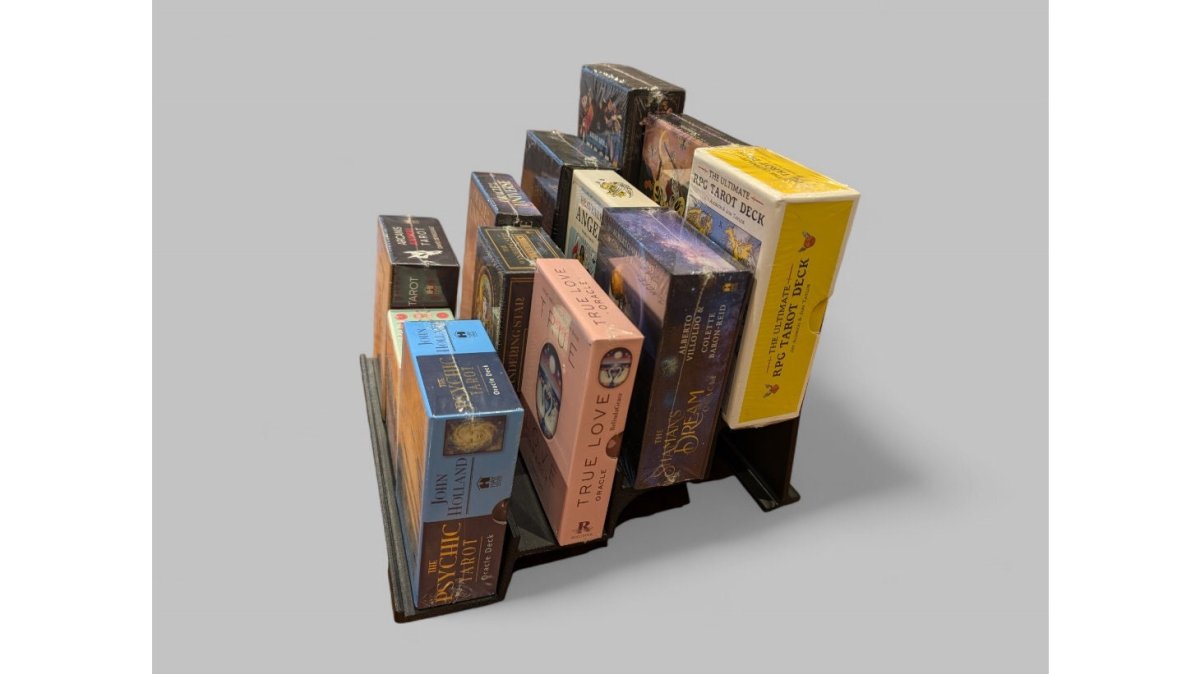
Here is how the options map to collection size:
| Shelf | Decks Held | Best For | Starting Price |
|---|---|---|---|
| Card Deck Display Stand | Step Shelf | Up to 8 | Starting collections | $12.09 |
| Card Deck Display Stand | Step Shelf Up to 12 Decks | Up to 12 | Growing collections | $12.09 |
| Poker & Tarot Card Deck Display Stand | Soft Case | Up to 18 | Large collections, soft cases | $12.09 |
| Tarot Oracle Card Display | Up to 16 | Thick oracle decks, altars | $20.99 |
| Poker & Tarot Card Deck Display Stand | Hard Case | Up to 18 | Decks in hard Carat cases | $23.89 |
Styling Your Oracle Shelf: Colors, Altar Placement, and Home Decor
Styling comes down to contrast and placement. A matte black shelf makes colourful deck art pop; a white shelf blends into a light wall and lets the cards carry the palette. Special silk metallic Gold, Silver, and Copper colors show a nice sheen in the right light.

A few styling moves that work:
- Group decks by colour family for a calm, cohesive look.
- Mix one metallic shelf with matte black for a maximalist design feel.
- Leave one empty slot so you can add a new deck without rearranging everything.
Styling Without Damaging: Light, Heat, and Dust on Display
The same open design that makes a tiered shelf beautiful also exposes your decks to light, heat, and dust.
- Light. Keep the shelf out of direct sun. UV fades card backs and warps boxes over time, and the effect is cumulative. If your only spot is bright, rotate which decks sit on the exposed side, or drape a cloth over the top row when the room is empty.
- Heat. A shelf near a radiator, heating vent, or sunny window can soften 3D printed stands and dry out card stock. A stable, room-temperature spot keeps both the shelf and the cards in shape.
- Dust. Open steps collect dust on the top edge of each deck, right where the pages meet the cover. A weekly pass with a soft brush or dry microfibre cloth keeps grit out of the deck itself, which is where scratches actually start.
A Styling Checklist That Protects as It Displays
Before you finalise a layout, run through this:
- Is the shelf out of direct sunlight for most of the day?
- Is it clear of heat sources like vents and radiators?
- Can you reach every deck without stretching or knocking the row behind it?
- Is there a cloth or deck bag within reach for decks you display but rarely use?
- Does the base sit flat and stable on the surface, with no overhang?
A styled shelf that answers yes to all five will look good and keep your collection in display condition for years.
Protecting Decks: Dust, Light, and Environmental Damage
Card protection is about three things: dust, light, and moisture. A tiered shelf helps with moisture by keeping decks off cold floors and out of sealed boxes, but you still have to manage the other two.
- Dust: Cover rarely used decks with a cloth, or keep them in deck bags when not on display.
- Light: Keep shelves out of direct sun. UV fades card backs and warps boxes over time.
- Moisture: Avoid damp rooms. A dry, ventilated space keeps cards flat.
Conclusion: Building a Shelf That Grows With Your Collection
The hard part is not buying a shelf. It is buying one that still fits when your collection doubles, and that means choosing modular over fixed. A self-standing tiered design lets you start small and add units as you go.
Frequently Asked Questions
How do you store a large collection of oracle decks without losing access to them?
Tiered shelves solve this by raising each row so nothing hides behind anything else. A 16-deck tower configuration, for example, lets you pull any deck without moving the ones in front. Group decks by theme or use frequency, then assign each group its own column. Because the shelves are self-standing, you can place them on a desk, dresser, or bookshelf rather than committing wall space, and add another unit as the collection grows.
Are tiered display shelves better than flat storage for oracle cards?
For decks you read regularly, yes. Flat storage stacks decks on top of each other, which hides the ones underneath and makes you lift and shift to reach them. Tiered shelves keep every deck visible and accessible from the front. Flat boxes still make sense for long-term archival storage of decks you rarely use, but for daily or weekly readers, a tiered step shelf cuts the friction of getting to your cards.
What should I look for in a high-quality 3D printed card display stand?
Check three things: slot depth, slot width, and side tabs. Oracle decks with guidebooks can run up to 51mm thick, so a shelf rated for that depth will not squeeze them. Each column should be wide enough for decks up to about 75mm across. Side tabs stop decks sliding off when you bump the shelf. Layer lines and minor surface texture are normal for 3D printing and do not affect how well the stand holds weight.
Can tiered shelves hold heavy decks without sagging or cracking?
A well-designed PLA shelf distributes weight across each step rather than concentrating it at one point, so a full row of thick decks sits stable. The practical limit is the step depth and the contact area under each deck. If you are storing very heavy boxed sets, choose a configuration with fewer rows and wider columns so each deck rests on more surface. A shelf built for 51mm decks handles standard oracle boxes without flexing.
How can I display oracle decks without wall-mounting anything?
Self-standing tiered shelves sit directly on a desk, altar, dresser, or bookshelf, so no drilling or brackets are needed. You can also stack or place units side by side to expand horizontally, and move the whole arrangement when you rearrange a room.
Collections grow. Shelves should keep up. The Card Shelf Workshop builds 3D printed tiered step shelves with modular, expandable designs, custom sizing for thick oracle decks, and finishes from matte black to silk metallic. With a 4.9 rating from 100 reviews, it is a setup built by a collector for collectors. Get started with The Card Shelf Workshop and give every deck a place you can actually see.