

Table of Contents
- Why Vertical Storage Works for Card Collections
- Graded Card Storage: Choosing Between Vertical and Horizontal
- Top Loader Storage Box Options and Real-World Capacity
- Trading Card Organization Ideas for Different Collection Types
- Card Storage Drawers and Modular Solutions
- Protection and Long-Term Preservation in Vertical Storage
- Setting Up Your Vertical Storage System
- Frequently Asked Questions
Last Updated: October 21, 2026
Why Vertical Storage Works for Card Collections
Vertical storage for card collections transforms how collectors organize, protect, and display their most valuable cards.

The real advantage goes beyond aesthetics. When cards sit vertically, weight distributes evenly across the shelf structure rather than concentrating pressure on a single point.
Most collectors start with storage boxes stacked in closets. That works until your collection outgrows the space or you want to actually enjoy looking at what you own.
Graded Card Storage: Choosing Between Vertical and Horizontal
Graded cards demand different storage logic than raw cards. A PSA, BGS, or CGC slab is a sealed protective case, it's designed to sit upright.
The choice between vertical and horizontal storage comes down to space, viewing preference, and collection size. Vertical storage maximizes wall or shelf space and lets you see card labels and grades without opening drawers.

For most collectors, vertical wins because graded slabs look impressive displayed. You paid for professional grading and certification, vertical storage shows that off.
Slab Dimensions and Compatibility
Standard PSA, BGS, and CGC slabs measure approximately 2.5" × 3.5" × 0.375" thick for regular cases. Thicker cases, used for high-value cards or vintage slabs, can reach 0.5" or more.
Your shelf must accommodate these dimensions precisely. Too loose and slabs shift during transport or when you're pulling one card out. Too tight and you risk scratching the protective case.
Capacity Planning for Graded Collections
Vertical storage capacity depends on shelf dimensions and how many rows you stack. A single-row shelf might hold 3-4 slabs horizontally. Multi-row configurations can display 9, 16, or more slabs in a compact footprint.
Plan your layout before buying. If you have 50 graded slabs, a 4×4 grid (16 cards) means you'll need three separate shelves or a modular system that expands.
Top Loader Storage Box Options and Real-World Capacity
Top loaders are rigid plastic sleeves that hold standard-size trading cards upright. They're cheaper than graded slabs but still provide strong protection.
Top loader storage boxes come in single-row, multi-row, and grid layouts. A single-row shelf holds 3-4 top loaders side by side. Multi-row configurations stack 4, 5, or even 6 rows vertically, displaying 16-20 cards or more depending on the grid.
Standard Toploader Dimensions and Fit
Standard top loaders for trading cards measure 3" × 4" and fit cards like Pokémon, Magic: The Gathering, and sports cards. The rigid case is roughly 0.25" thick.
Most vertical shelves designed for top loaders space rows 2-3 inches apart. This gives you enough clearance to insert and remove cards without forcing them. Tighter spacing saves room but makes retrieving cards awkward, you'll bump adjacent cards when pulling one out.
Multi-Row Displays and Overlap Considerations
A 4×4 grid (16 top loaders) fits comfortably in a space roughly 12" wide and 12" tall. A 4×5 grid (20 top loaders) adds another row, increasing height to around 15".
Dense configurations are space-efficient but require careful arrangement. If you rotate your display frequently or want to see every card label clearly, stick with 4-row or fewer grids. If space is tight and you prioritize capacity over perfect visibility, 5-row grids work well.
Trading Card Organization Ideas for Different Collection Types
Organization systems make vertical storage practical. Without structure, even a beautiful display becomes chaotic. The key is matching your organization method to your collection type and how you actually use your cards.
Organizing by Card Type and Protective Sleeve
Separate your collection by card type first: graded slabs, top loaders, raw cards in sleeves, and specialty items like foil or holographic cards. Each type may need different storage solutions.
Within each category, organize by game, set, or collection focus. MTG players often sort by color or format. Pokémon collectors organize by set number or card rarity. Sports card collectors might group by player or team.
Quick Access and Viewing Systems
Quick access means retrieving a card in seconds without disturbing others. Vertical storage excels here because cards sit at eye level and you can see labels without opening containers.
Set up your vertical storage so frequently used cards are at eye level and less-used items are higher or lower. Keep a small working area next to your display where you can safely pull cards out and examine them without crowding the shelf.
Card Storage Drawers and Modular Solutions
Card storage drawers work well for collections you want to keep organized but less visible.
Modular solutions combine the best of both: a vertical display shelf for your favorite or high-value cards, plus drawer storage underneath for the rest of your collection.
Modular systems also expand as your collection grows. Start with a single shelf unit and add more as needed.
Modular Graded Card Display Shelf for PSA BGS CGC | Expandable 3x3 Slab Stand →
Protection and Long-Term Preservation in Vertical Storage
Vertical storage protects cards better than many alternatives, but only if you account for environmental factors and weight distribution. The goal is keeping your cards visible while minimizing damage from light, humidity, temperature swings, and physical stress.
Environmental Factors and Durability
Direct sunlight fades card colors and degrades protective sleeves. Store your vertical display away from windows or use UV-filtering glass or acrylic covers if the shelf sits in bright areas.
Temperature swings are harder to control in most homes, but extreme heat weakens plastic cases and causes cards to warp.
Your shelf material also matters. 3D-printed display stands made from quality PLA filament are durable and lightweight, but they're not indestructible.
Weight Distribution and Structural Integrity
Each card or slab has weight. A single graded slab weighs a few ounces, but a full 4×4 grid holding 16 slabs adds up quickly. Vertical shelves must distribute this weight evenly across the entire structure, not concentrate it on a few support points.
Quality display stands use internal ribbing and support structures to handle weight without sagging or bending. Cheap shelves flex under load, which stresses the cards and can cause slabs to shift or fall.
Setting Up Your Vertical Storage System
Setup is straightforward, but a few steps make the difference between a professional-looking display and a chaotic pile.
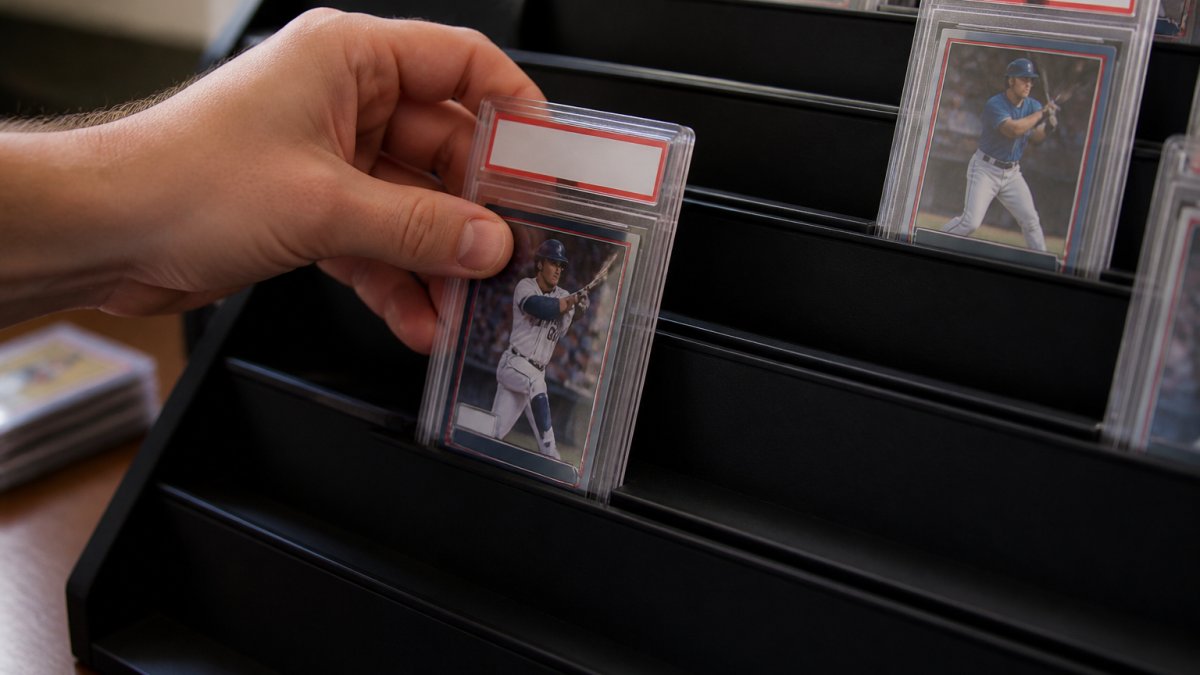
Assembly and Customization
Most vertical shelves arrive as flat-pack components that snap or slide together without tools. Read the assembly instructions first, they'll tell you the correct order and which pieces go where.
Customization starts with placement. Decide where your shelf will live before assembly.
Start with your most valuable or favorite cards in the center rows where they're most visible. Put less-used cards on the top or bottom rows.
Common Mistakes to Avoid
The biggest mistake is overcrowding.
Another common error is ignoring weight distribution. Don't load all your heaviest slabs in one row.
Don't store your shelf in direct sunlight or near heat sources. Cards fade and protective sleeves degrade under UV light and heat.
Finally, avoid handling cards constantly. Vertical storage is meant to reduce handling by keeping your collection visible.
Vertical storage for card collections works because it solves the core problem every collector faces: how to keep cards safe while actually enjoying them. The Card Shelf Workshop's modular display shelves are engineered specifically for this, our 3D-printed stands hold PSA, BGS, and CGC slabs securely while expanding as your collection grows.

Frequently Asked Questions
Is it safe to store trading cards vertically?
Yes, vertical storage for card collections is safe when done correctly. Cards stored upright in proper holders, such as toploaders, magnetic holders, or tiered displays, experience minimal stress compared to horizontal stacking. The key is using dividers or individual slots to prevent cards from leaning or shifting. Graded slabs are especially well-suited to vertical storage since their rigid cases protect the card itself. Ensure your shelf or storage box is level and stable to prevent cards from sliding.
What's the best way to organize graded card storage?
Graded card storage benefits from vertical display that showcases each slab's label and artwork. Use a modular tiered display system that accommodates standard slab thicknesses (typically 10mm to 13mm). Organize by card type, grade, or collection theme. A 3x3 or 4x4 grid layout works well for most collectors. Ensure your shelf has proper alignment pins or channels to keep slabs secure and prevent them from tipping. Consider expandable systems so your storage grows with your collection.
How many cards can fit in a top loader storage box?
Capacity depends on the box configuration and card type. A 4x4 grid display holds 16 standard toploaders, while a 4x5 grid holds 20. Standard toploaders are 3 inches by 4 inches. Real-world capacity also depends on whether cards overlap slightly in multi-row setups. For loose cards without protective sleeves, capacity varies significantly by box dimensions. Calculate based on your specific box measurements and the protective sleeves or holders you're using. Modular systems let you expand as your collection grows.
Can vertical card storage damage cards over time?
Vertical storage does not damage cards when they're properly supported and protected. Cards in rigid toploaders or magnetic holders remain stable and protected from bending or creasing. Graded slabs are engineered to hold cards safely upright. The main risk is improper support, cards leaning against each other without dividers, or shelves that aren't level or sturdy enough. Choose storage with secure slots, alignment pins, or dividers. Avoid overloading shelves beyond their weight capacity, and keep storage away from direct sunlight and extreme temperature changes.
What's the difference between vertical and horizontal card storage?
Vertical storage displays cards upright in tiered shelves or grid systems, making every card visible and accessible. Horizontal storage stacks cards flat in boxes or drawers, maximizing space but limiting visibility. Vertical storage works better for display and quick access to individual cards. Horizontal storage suits long-term archival storage or large collections where aesthetics matter less. For graded cards and valuable slabs, vertical display is preferred because it showcases the card art and label. Your choice depends on whether you prioritize display, access, or space efficiency.
How do I keep cards from leaning or falling over in storage?
Use dividers, alignment pins, or custom slots to hold each card in place. Tiered display shelves with individual slots prevent cards from shifting. Ensure your storage box or shelf is perfectly level, even slight tilts cause cards to lean. For toploaders and magnetic holders, snug-fitting channels keep them upright. Avoid overpacking rows; crowding causes cards to tilt. If using a modular system, secure expansion pieces with pins or fasteners so the entire structure remains rigid. Check your shelf regularly to confirm cards haven't shifted.
Can the same shelf system work for both graded cards and tarot decks?
It depends on the shelf design and dimensions. Graded slabs are typically 2.5 by 3.5 inches and up to 13mm thick. Tarot decks vary in size but are usually taller and narrower. Some modular tiered systems accommodate both by offering adjustable slots or multiple configuration options. However, most specialized graded card displays are engineered specifically for slab dimensions. If you collect both, consider separate display systems optimized for each. The Card Shelf Workshop offers tiered shelves designed for different collection types, so check product specifications to confirm compatibility with your decks.
How durable are 3D-printed card storage shelves compared to wood or metal?
3D-printed shelves made from PLA (Polylactic Acid) are durable and lightweight, with excellent strength-to-weight ratios. They resist warping and are less prone to humidity damage than wood. However, they're more sensitive to extreme heat than metal or solid wood. For typical indoor collectors, 3D-printed shelves perform reliably for years. Quality matters: precision-engineered 3D-printed displays with proper wall thickness and reinforced channels outlast poorly made alternatives. Your shelf's durability depends on design, material thickness, and usage. Most collectors report no issues with 3D-printed displays when used as intended.