

Quick Summary
To organize trading card decks on a desk, use a self-standing tiered display that sits on the desk rather than the wall. Sort your cards by game, set, and type first, then place active decks on the middle tier, inactive decks on the top tier, and unfinished decks on the bottom.
- Use a self-standing tiered display that sits on the desk and needs no wall mounting.
- Sort cards by game first, then by set, then by card type or color.
- Keep two or three active decks on the middle tier, closest to your hands.
- Store finished decks on the top tier and unfinished decks on the bottom tier with a note of missing cards.
- Return every deck to its box and spot after each play session to keep the system intact.
Table of Contents
- Why a Desk Setup Works Better Than a Pile
- What You Need Before You Start
- How to Sort Cards for Deck Building
- Setting Up a Tiered Display Stand on Your Desk
- A Desk Workflow for Active, Inactive and Unfinished Decks
- Trading Card Deck Storage Ideas for Small Desks
- Protecting Your Decks from Desk Hazards and Keeping the System Tidy
- Set Up Your Desk Deck System This Weekend
- Frequently Asked Questions
How to Organize Trading Card Decks on a Desk
Last Updated: October 28, 2026
Why a Desk Setup Works Better Than a Pile
A shoebox, a drawer, or a stack on the corner of the desk can make it harder to organize trading card decks when you need one fast. Then you're digging through sleeves and dividers while the timer runs.
At The Card Shelf Workshop, we build self-standing tiered displays for trading card decks. Our shelves sit on the desk, not the wall, so your setup stays flexible as your collection changes. A tiered layout turns a pile into a system you can see at a glance. Integrating these tiered displays into a broader workspace strategy often requires coordinating your card storage with other desk organizers for workers to maintain a clean and efficient environment.
The idea is simple. Each deck gets a fixed spot, and every spot is in plain view.
What You Need Before You Start
Gather these items before you move anything:
- A self-standing tiered display. Our shelves are freestanding and built to sit on a desk. They are not wall-mounted, so you can move them without drilling anything.
- Sleeves and deck boxes. Keep each deck protected inside its own box or sleeve so the stack stays clean. Compare deck box and binder storage options before you buy supplies.
- Labels or small tabs. Label each tier so you know what goes where.
- A clear surface. Clear enough room for the display and a play mat.
- Your full card list. Count your decks so you know how many spots you need.
Watch out: Don't buy a display sized for today's collection only. Decks multiply fast. Leave at least one open spot on your shelf for the next one.
How to Sort Cards for Deck Building
Sorting comes before display. Once your cards are sorted, building a deck takes minutes instead of hours.
Use this order:
- Sort by game. Separate each trading card game into its own pile.
- Sort by set or expansion. Within each game, group cards by set.
- Sort by card type or color. Split creatures, spells, and other types, or sort by color where the game uses it.
- Set aside bulk. Keep common, low-value cards in their own container so they don't clutter your decks.
- Pull out valuable cards. Store high-value cards separately in a protected binder or box.
| Sorting Step | What It Separates | Where It Goes |
|---|---|---|
| 1. By game | Each trading card game | Separate piles |
| 2. By set | Expansions and sets | Within each game |
| 3. By type or color | Card attributes | Dividers or sections |
| 4. Bulk | Common, low-value cards | Its own box |
| 5. Valuable | High-value pulls | Protected binder or box |
Once sorted, build your decks from the sorted piles. Put each finished deck into its box and place it on a tier.
Setting Up a Tiered Display Stand on Your Desk
A tiered display should fit your desk and your reach. Start by clearing the surface completely, not just pushing things aside. Leave enough room for the display plus a play mat or keyboard.
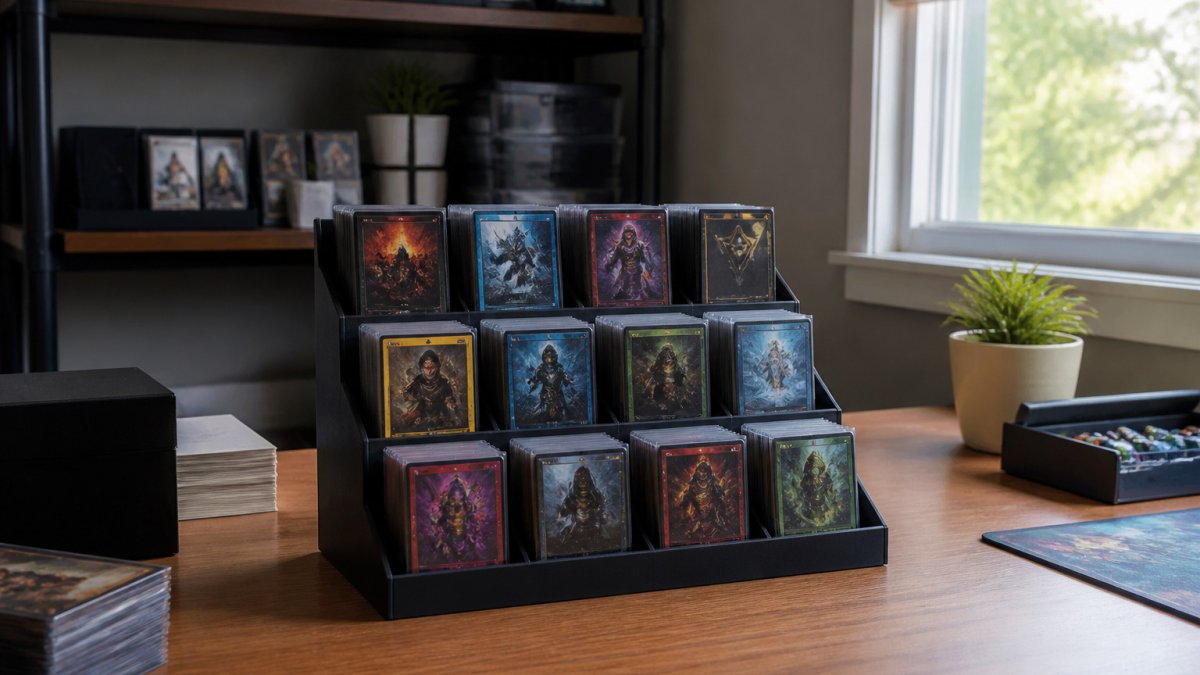
Measure your desk depth and width before placing anything. Leave clear space in front of the display for your play area.
Place your self-standing tiered display where you sit most often, within arm's reach. A poker deck display stand with a compact tiered layout suits this kind of desk setup. The top tier should be at eye level or slightly below. The middle tier, your active decks, should be closest to your hands. The bottom tier can hold less-used items.
!A tidy desk in a home game room with a self-standing tiered display stand holding several sleeved trading card decks in rows, natural daylight from a nearby window
Load the shelf in this order:
- Active decks on the middle tier. These are the decks you play this week. Keep them at forearm height so you can grab one without standing up.
- Inactive decks on the top tier. Finished decks you're not playing stay visible but out of the way. Label each spot so you don't have to pull them out to check.
- Unfinished projects on the bottom tier. Decks still being built go here, along with a small note card listing missing cards.
- Label each tier with a small tab. Use removable labels so you can relabel when decks rotate.
The tiers keep each deck separate. Because the display is self-standing, you can move it to another desk or table, just lift and reposition.
Watch out: Don't overload the top tier with heavy deck boxes. Keep heavier items on the bottom tier for stability, especially if your desk gets bumped.
Collapsible Trading Card Display Shelf | TCG MTG CCG →
A Desk Workflow for Active, Inactive and Unfinished Decks
Most players mix up three kinds of decks. A simple status system keeps them apart and tells you what to do next.
- Active decks: Decks you play now. Keep these on the middle tier, closest to your hands. Limit this tier to two or three decks so you don't crowd your play space.
- Inactive decks: Decks you've finished but don't play. Store these on the top tier, labeled and ready to swap in when you want a change.
- Unfinished decks: Decks still in progress. Keep these on the bottom tier with a note card listing what's missing, specific cards, quantities, or trades pending.
Use a simple tracking method: a small whiteboard, a index card, or a notes app on your phone. Write each deck's name, status, and any missing cards. Update it when you move a deck between tiers.
Review your tiers regularly. The guide to tiered shelves for deck collections walks through setting up active, inactive and unfinished tiers. Move a deck between tiers if its status has changed, finished a deck? Move it from bottom to top. Starting a new project? Move an inactive deck down to make room.
For deck building, pull cards from your sorted bulk storage, not from your displayed decks. Keep a small box on the desk for cards you're willing to trade. When you acquire new cards, sort them into your bulk system first, then update your unfinished deck notes.
At the end of each play session, return every deck to its box and its spot on the shelf. This one habit keeps your desk clear and your system intact.
Trading Card Deck Storage Ideas for Small Desks
A few ideas for a small desk:
- Stack by height. Use tiers instead of flat piles so each deck stays visible.
- Keep the display narrow. A compact footprint leaves room for your play mat and keyboard.
- Store bulk elsewhere. Move common cards to a drawer or box out of the way.
- Go vertical. A tiered shelf uses height rather than width, which saves desk space.
Measure your desk before you buy. Make sure the display fits with room to spare for play.
Protecting Your Decks from Desk Hazards and Keeping the System Tidy
A few habits for your collection:
- Keep drinks on a separate coaster, away from the display.
- Dust the shelf weekly with a soft cloth.
- Keep the display out of direct sunlight to prevent fading.
- Always return decks to their boxes after play.
Our shelves are made from PLA. Minor surface imperfections are a natural result of the 3D-printing process. Custom colors are available.
Reset your system once a month. Check each tier, move decks that changed status, and remove anything that doesn't belong.
Set Up Your Desk Deck System This Weekend
Start small. Sort one game this weekend, load one tier, and label it. Add the rest as you go.
Our tiered display stands are self-standing. Browse our display shelf options.

Frequently Asked Questions
How should I organize trading card decks on a desk?
Start by grouping decks by the game or format you play most often, then place active decks on a self-standing tiered display within arm's reach. Keep inactive and unfinished decks in a separate box or drawer. Label each tier or box, and reset the desk at the end of each session.
What is the best way to sort trading cards for deck building?
Sort first by game, then by set or expansion, then by card type or color inside each set. Within each group, arrange cards by collector number or alphabetically so you can locate a specific card quickly. Pull out cards you want to keep for trades or valuable pulls and store them separately from bulk commons, so your deck-building pile contains only the cards you actually plan to use.
Should trading cards be stored vertically or horizontally?
For a desk display, you can arrange cards upright on tiers.
How do I keep my trading cards protected while displaying them on a desk?
Keep the display away from the edge of the desk.
