

Last Updated: October 30, 2026
Quick Summary
Yes, plastic sleeves are safe for trading cards as long as they are PVC-free, such as polypropylene or polyethylene. PVC sleeves can release plasticizers that stick to card surfaces and leave permanent residue, so check the recycling code before storing anything valuable.
- Polypropylene is marked 5, polyethylene 2 or 4, and PVC 3 on recycling codes.
- PVC feels soft and rubbery and has a chemical odor, while safe sleeves feel stiff and smell like nothing.
- Sleeve high-value cards first, then add a top loader or rigid case.
- Check stored cards every six months for curling, warping, stickiness, or yellowing.
- Keep displays out of direct sun and avoid stacking heavy objects on sleeved cards.
Table of Contents
- Are Plastic Sleeves Safe for Trading Cards?
- Why Card Protection Matters
- Card Sleeve Material Guide: What to Look For
- PVC-Free Card Sleeves: The Safe Choice
- Card Sleeves or Binder: Which Is Better?
- Long-Term Trading Card Storage: Conditions and Inspection
- Sleeve Fit, Handling, and Storage Risks
- Displaying Sleeved Cards Safely
- Frequently Asked Questions
Are Plastic Sleeves Safe for Trading Cards?
Yes, plastic sleeves are safe for trading cards, provided they are made from PVC-free plastic such as polypropylene or polyethylene. The risk comes from a specific material, not from sleeving itself. Damage usually starts with the wrong sleeve.
The short answer: safe sleeves protect against scratches, edge wear, and dust. Unsafe ones can stick to card surfaces over years and leave a cloudy residue that will not come off. Below, we'll show you exactly how to tell the two apart, how to fit a sleeve correctly, and how to store sleeved cards so they stay safe for decades.
Why Card Protection Matters
Cards damage easily. A bare card picks up surface scratches from a binder page, edge wear from a box, and corner damage from a single careless shuffle. Sleeves absorb all of that.
Protection matters most for high-value cards, since a crease can reduce a card's value.
It also keeps cards clean. Dust and skin oils build up on exposed surfaces. A sleeve keeps fingers off the card entirely.
Card Sleeve Material Guide: What to Look For
Sleeve material decides whether a sleeve protects a card or slowly harms it. Three plastics show up in card storage, and only two are safe for long-term use.
- Polypropylene (PP): Clear, stiff, acid-free, and the standard for most card sleeves. Safe for long-term storage.
- Polyethylene (PE): Softer and more flexible. Common in inner sleeves. Also safe.
- PVC (polyvinyl chloride): Soft and cheap, but unstable. It can release plasticizers that react with card surfaces.
When you shop, check the packaging for "acid-free," "archival safe," or "PVC-free." Reputable makers print it clearly. If the label says nothing, treat the sleeve as unknown until you test it.
Three plastics show up in card storage, and only two are safe for long-term use.
| Material | Key traits | Safe for long-term storage |
|---|---|---|
| Polypropylene (PP) | Clear, stiff, acid-free; standard for most sleeves | Yes |
| Polyethylene (PE) | Softer, more flexible; common in inner sleeves | Yes |
| PVC (polyvinyl chloride) | Soft and cheap, but unstable; releases plasticizers | No |
PVC-Free Card Sleeves: The Safe Choice
PVC-free card sleeves are the only kind we recommend for anything you care about. The problem with PVC is chemical, not cosmetic.
Over time, PVC breaks down and releases plasticizers. Those chemicals can migrate into a card's surface, causing discoloration, a greasy feel, or sticking. Once that happens, the damage is permanent. The mechanism is straightforward: plasticizers are added to PVC to make it flexible, and they are not chemically bound to the plastic. They migrate out over time, especially in heat, and card stock absorbs them.
PVC also off-gasses in heat. A box of PVC sleeves in a warm room is a slow-motion problem for every card inside. The warmer the storage area, the faster the migration.
How to identify sleeve material when the packaging is unclear:
- Check the recycling code. PP is marked 5, PE is marked 2 or 4, and PVC is marked 3.
- Squeeze the sleeve. PVC feels soft and rubbery; polypropylene feels stiff and springs back.
- Smell it. PVC has a distinct chemical, plastic odor. Safe sleeves smell like nothing.
- Bend a corner. PVC whitens and creases; PP holds its shape better.
- Check the clarity. PVC often has a slight blue or yellow tint; PP and PE are clearer.
If you cannot confirm the material, do not store high-value cards in it. Use it for bulk instead.
A note on “archival” claims: Many sleeves are marketed as “archival safe” without listing the plastic. Treat that phrase as a starting point, not a guarantee. Look for the recycling code or an explicit “PVC-free” statement. If neither is present, assume the sleeve is PVC until proven otherwise.
Card Sleeves or Binder: Which Is Better?
Card sleeves and binders solve different problems, and most collections need both. Sleeves protect individual cards. Binders organize and store many cards in one place.
The right setup depends on how you use the cards:
- Playing decks: sleeves only. You need the cards accessible and shuffleable.
- Bulk collection: binder pages, with sleeves on anything worth more than a few dollars.
- High-value cards: sleeve first, then a top loader or rigid case.
- Display pieces: sleeve, then a display stand where you can actually see them.
The short version: sleeves win for play, binders win for browsing, and the two work best together. For a deeper comparison of deck boxes vs binders for storing decks, read our full guide.
Trading Card Display Shelf for Top Loaders | Pokemon, MTG, Sports Card Wall →
Long-Term Trading Card Storage: Conditions and Inspection
Long-term storage is where sleeves earn their keep, but the room matters as much as the plastic. Heat, moisture, and sunlight cause more damage than most collectors realize.
Keep stored cards in a cool, dry, dark place. Avoid attics, garages, and anywhere near a radiator or window. Humidity is the quiet killer: it warps cards and encourages mold in paper stock.
Build an inspection habit: If you have a large collection, our guide to storing heavy card collections safely covers weight and shelving concerns.
- Check stored cards every six months
- Look for curling, warping, or a wavy edge
- Feel for sticky or greasy surfaces on sleeved cards
- Check for discoloration or yellowing
- Replace any sleeve that looks cloudy, creased, or stiff
- Confirm the storage area stays dry and out of direct sun
Sleeve Fit, Handling, and Storage Risks
Sleeve fit is the most overlooked risk in card storage. A sleeve that is too tight bends cards during insertion. One that is too loose lets the card slide out and pick up edge wear. The damage often shows up as edge whitening or corner dings that weren't there before sleeving. Rigid protection avoids these mechanical stresses entirely, though collectors should weigh the specific risks associated with magnetic card cases before transitioning their most valuable inventory.
Match the sleeve to the card. Our vertical storage guide compares box types, capacity, and display solutions for collectors. Standard-size cards (2.5" x 3.5") need standard-fit sleeves. Japanese-size cards (2.5" x 3.5" but slightly thinner stock) need their own smaller fit. Perfect-fit inner sleeves sit snug against the card; standard outer sleeves go over them. A perfect-fit sleeve should slide on with light resistance, not require force.
Double-sleeving adds a layer: a perfect-fit inner sleeve, then an outer sleeve. It protects against moisture and handling, and it is standard practice for competitive play. The inner sleeve should be slightly shorter than the card to avoid overlapping edges that can catch.
Insertion technique matters more than most collectors realize. Pushing a card into a tight sleeve by the corner is how corners get bent. Insert the card slowly, straight down, and stop if you feel resistance. A common pattern is to hold the sleeve open with two fingers and let the card slide in under its own weight. If you have to push, the sleeve is too tight.
Watch for these fit-related damage signs:
- Edge whitening along the top or sides
- Corner dings from forced insertion
- Curling or bowing from a sleeve that is too tight
- Card sliding out of a loose sleeve and picking up dust or scratches
Handling matters too. Hold cards by the edges, never the face. Keep sleeves clean, and replace any sleeve with grit inside it. Grit acts like sandpaper every time the card moves.
The same fit principles apply: a card should rest in its slot without pressure on the face or edges.
Displaying Sleeved Cards Safely
Displaying sleeved cards safely means keeping them visible without pressure, sunlight, or dust doing damage. Sleeves protect against handling, but they do not block UV light.
Keep displays out of direct sun. Rotate cards periodically so the same face is not always exposed. And avoid stacking heavy objects on sleeved cards, which can press creases into the card inside.
This is where a proper stand helps. For a deeper look at showing off toploaders and slabs, see how to properly display graded slabs and toploaders. A tiered display shelf holds sleeved cards upright, spaced apart, with no weight on the cards themselves. At The Card Shelf Workshop, our trading card display shelf is a self-standing tiered display and is not wall-mounted.
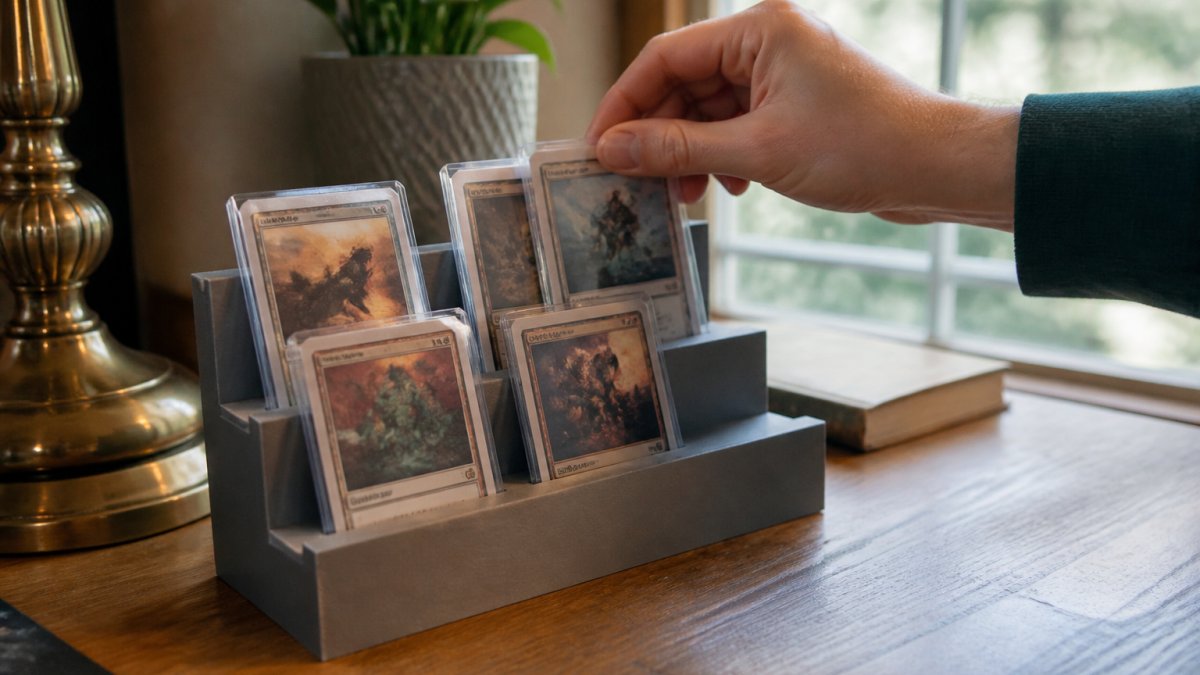
The same principles apply: no pressure, no direct sun, and a stand that holds each card on its own.
Frequently Asked Questions
Are plastic sleeves safe for storing trading cards?
Yes, plastic sleeves are safe when they are made from PVC-free materials such as polypropylene or polyethylene. These plastics are acid-free and do not release harmful chemicals that can damage cards over time. Avoid sleeves made from PVC, which can become sticky and degrade. Check the packaging or feel for a strong plastic odor as a warning sign. For high-value cards, double-sleeving with a perfect-fit inner sleeve and a standard outer sleeve adds extra protection.
Can plastic sleeves damage or stick to cards over time?
Only certain plastics, like PVC, can stick to cards over time, especially in heat or humidity. PVC sleeves may release plasticizers that cause cards to become tacky or discolored. Polypropylene and polyethylene sleeves are stable and will not stick under normal storage conditions. To be safe, inspect your collection every 6 to 12 months for any signs of sticking, discoloration, or warping, and replace any sleeves that feel stiff or cloudy.
Do Yu-Gi-Oh cards fit in Pokémon sleeves?
Yu-Gi-Oh cards are slightly smaller than Pokémon cards, so they will fit inside standard Pokémon sleeves, but they may slide around. For a snug fit, use perfect-fit inner sleeves designed for Yu-Gi-Oh size. Standard outer sleeves for Pokémon are 66mm x 91mm, while Yu-Gi-Oh cards are about 59mm x 86mm. If you double-sleeve, use a perfect-fit inner sleeve first, then a standard outer sleeve to keep the card secure.
Should expensive cards be stored in sleeves and binders?
Expensive cards benefit from a layered approach: a perfect-fit inner sleeve, a standard outer sleeve, and then a rigid holder such as a top loader or card saver for display or storage. Bindes are fine for organization, but avoid ring binders that can dent cards. For long-term storage, keep binders in a cool, dry place away from sunlight. If displaying, use a tiered shelf like the Trading Card Display Shelf for Top Loaders to keep cards visible and protected.
Sleeving is the easy part. Keeping a growing collection organized and on display without damage is where most collectors get stuck. The Card Shelf Workshop builds 3D-printed display stands with modular, expandable designs and tiered step configurations, so your sleeved cards and slabs stay visible and accessible instead of buried in a box. Get started with The Card Shelf Workshop and give your collection the display it deserves.
