

Last Updated: November 2, 2026
Quick Summary
The 10 best storage for sleeved trading cards are row boxes for bulk, binders and portfolios for trade stock, plastic cases and bins for long-term storage, deck boxes for active decks, and display shelves for favorites. Match the container to the sleeve, since a sleeve adds thickness that generic boxes and pages were not sized for.
- An 800-count row box holds roughly 600 to 650 standard sleeved cards.
- Side-loading binder pages accept sleeved cards more gracefully than top-loading pages.
- Measure a 10-card sleeved stack and divide row length by average thickness.
- Leave a finger's width of slack in each row so cards do not bow.
- Keep heavy boxes low, never on a top shelf, and weigh a full box before stacking.
Table of Contents
- Quick Comparison: Top Storage Picks for Sleeved Cards
- Trading Card Storage Boxes: Bulk and Row Options
- Trading Card Binders: Pages and Portfolios for Sleeved Cards
- Card Storage Box Capacity: How Many Sleeved Cards Fit?
- TCG Card Organization: Sorting and Access Systems
- Display Shelves for Sleeved Cards: Show Off Your Collection
- Protecting Sleeved Cards from Damage and Environment
- Choose Your Sleeved Card Storage Solution
- Frequently Asked Questions
Quick Comparison: Top Storage Picks for Sleeved Cards
Finding the 10 best storage for sleeved trading cards starts with one hard truth: a sleeve adds thickness, and most generic boxes and pages were sized for bare cards. At The Card Shelf Workshop, we build display shelves for collectors. The short answer: match the container to the sleeve, not the other way around.
Sleeved trading card storage is any box, binder, case, or shelf built to hold cards while they stay inside protective sleeves, with enough internal clearance that the sleeve does not bend or catch. The difference between a box that fits sleeved cards and one that only fits raw cards decides whether your collection stays flat and protected.
Here is a short list of common options:
| Storage Type | Best For | Sleeve Fit | Access Speed |
|---|---|---|---|
| Row storage boxes | Bulk sleeved collections | Good in wider rows | Medium |
| Binders and portfolios | Browsing and trading | Good in side-loading pages | Fast |
| Plastic cases and bins | Long-term, dust-free storage | Varies by insert | Slow |
| Deck boxes | One active deck | Exact fit by design | Fastest |
| Display shelves | Showcasing favorites | Holds sleeved and toploaded cards | Fast |
Below, we break down each option, how many sleeved cards it actually holds, and where collectors get the fit wrong.
Trading Card Storage Boxes: Bulk and Row Options
Cardboard row boxes are a common choice for trading card storage. A standard row box holds a few hundred unsleeved cards, but sleeved cards eat space fast: each sleeve adds bulk, so a row that swallows 500 bare cards may hold noticeably fewer once everything is sleeved.
The fix is simple. Buy boxes with taller, wider rows, or step up to multi-row boxes where you can dedicate one row to sleeved decks and another to bulk. If you are weighing boxes against other methods, see this comparison of deck boxes versus binders for storing and playing. Watch out: overstuffing a row bows the cards in the middle, and that bend becomes permanent over months.
Trading Card Binders: Pages and Portfolios for Sleeved Cards
Trading card binders make browsing a collection easier. A binder with loose-leaf pages lets you flip through a collection without touching each card, and side-loading pages accept sleeved cards more gracefully than top-loading pages, which can catch the sleeve edge on the way in.
Two rules keep binders safe. First, use pages sized for the sleeve, not just the card; a snug page creases the sleeve corner every time you turn it. Second, store binders flat or upright and full, never half-empty and leaning, because uneven pressure warps the pages and the cards inside.
A card portfolio works the same way for smaller collections. It is lighter and more portable than a full binder, which matters if you trade at events.
Card Storage Box Capacity: How Many Sleeved Cards Fit?
Card storage box capacity is the number of cards a box holds once sleeves are on, and it is generally lower than the advertised unsleeved count, since sleeve thickness adds bulk per card.
Here is a practical way to estimate usable capacity without guessing:
- Measure a stack of 10 sleeved cards with digital calipers or a ruler. Divide by 10 to get average thickness per card.
- Measure the internal length of the box row (not the external size).
- Divide row length by average card thickness to get a realistic count, then subtract 5-10% for slack so cards are not compressed.
For common row boxes, collectors report these rough ranges (always verify with your own sleeve brand):
| Box Type | Unsleeved Capacity | Standard Sleeved | Double-Sleeved |
|---|---|---|---|
| 800-count row box | ~800 | ~600-650 | ~500-550 |
| 500-count row box | ~500 | ~375-400 | ~300-350 |
| 3,200-count multi-row | ~3,200 | ~2,400-2,600 | ~2,000-2,200 |
These are estimates, not guarantees. Sleeve brand, card thickness (foils and older cards vary), and how tightly you pack all shift the number. The key is to leave a finger's width of slack in each row so cards do not bow. Overstuffing a row bows the cards in the middle, and that bend becomes permanent over months.
Weight matters as much as count. For more on keeping large, heavy collections safe, read how to store heavy card collections safely. A full 800-count row box of double-sleeved cards can weigh several pounds; stacking several on a flimsy shelf invites a collapse. Keep heavy boxes low, never on a top shelf, and weigh a full box before stacking another on top.
Use this checklist before you buy:
Collapsible Trading Card Display Shelf | TCG MTG CCG →
- Count your sleeved cards, not your raw cards
- Measure your actual sleeve thickness with a 10-card stack
- Add roughly a third more space for double-sleeved cards
- Leave a finger's width of slack in each row
- Weigh a full box before stacking another on top
- Keep heavy boxes low, never on a top shelf
TCG Card Organization: Sorting and Access Systems
TCG card organization is the system that decides how fast you find a card, not just where it sleeps. Most collectors start with a pile and end with a system that breaks down when the collection grows. A durable system sorts by use case first, then by set or format, and only then by color or rarity. For a deeper guide, see the best way to organize MTG cards.
Here is a workflow that scales from a few hundred cards to tens of thousands:
- Separate by use case. Active decks, trade stock, bulk, and showpieces each get a different storage path. Do not mix them in the same box.
- Sort each category by set or format. For active decks, keep the deck together in a deck box. For trade stock, sort by set and then by value so you can flip to the right page quickly.
- Decide what gets sleeved. Bulk cards can live loose in a row box; playables and favorites go into sleeves and then into binders or display. Sleeving everything wastes sleeves and space.
- Label at the container level. A strip of tape with the set name and date on each row box or binder spine saves ten minutes of digging later.
A simple access hierarchy works for most collectors:
- Active decks in deck boxes, within arm's reach
- Trade stock in a binder, sorted by value
- Bulk in labeled row boxes, stored low
- Showpieces on display, out of direct sunlight
For binders, use side-loading pages sized for sleeved cards and store the binder flat or upright and full. A half-empty binder leaning on a shelf warps pages and cards. For row boxes, keep rows loosely packed and avoid stacking heavy boxes high.
If you display favorites, a self-standing tiered shelf keeps sleeved cards and toploaders visible and accessible without wall mounting. The key is channel width: a shelf cut for bare cards pinches a sleeved card, while proper clearance lets the sleeve sit flat.
Display Shelves for Sleeved Cards: Show Off Your Collection
Storage hides cards; display celebrates them. A self-standing tiered shelf keeps sleeved cards and toploaders visible and accessible. Our dual-use trading card display shelf is a self-standing tiered display.

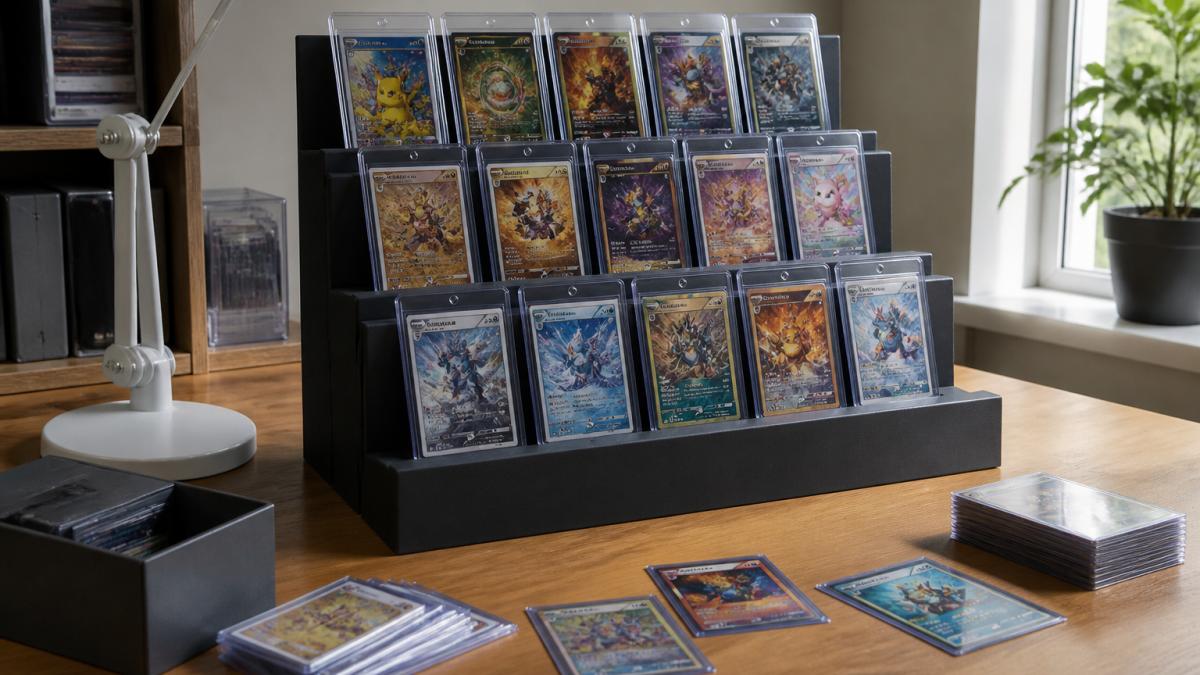
The key detail most shelves miss is channel width. A shelf cut for bare cards pinches a sleeved card; a shelf with proper clearance lets the sleeve sit flat without pressure on the edges.
Best for: collectors who want favorites visible and reachable. Skip if: you need to store thousands of bulk cards, which belongs in boxes.
Protecting Sleeved Cards from Damage and Environment
Protection is where cheap storage fails quietly. Sleeves guard against handling, but they do nothing about humidity, dust, light, or impact. Before trusting sleeves for long-term storage, it helps to know whether plastic sleeves are safe for trading cards. Keep storage away from radiators, windows, and damp basements, and keep boxes closed so dust stays out.
Impact is the sneaky one. A box dropped on a corner transfers force straight through the stack. Store heavy boxes on the floor or a low shelf, never on top of a cabinet where a bump sends them over.
Choose Your Sleeved Card Storage Solution
Picking from the 10 best storage for sleeved trading cards comes down to three questions: how many sleeved cards you own, how often you touch them, and whether you want them hidden or shown. Bulk goes in row boxes. Trade stock goes in binders. Active decks go in deck boxes. Favorites go on display.
Here is the challenge: most collectors own a mix of all four, and a single storage type never covers it. That is where we come in. The Card Shelf Workshop makes 3D-printed, self-standing tiered display shelves, with custom orders available for specific collections. Get started with The Card Shelf Workshop and give your best sleeved cards the shelf they deserve.
Frequently Asked Questions
What is the best way to store trading cards in sleeves?
Use a combination of rigid storage for high-value cards and binders or boxes for bulk. For sleeved cards, choose storage that matches the sleeve thickness: top loaders need wider slots, while standard penny sleeves fit most binders and boxes. Keep storage upright to prevent bending, and avoid overcrowding. For display, self-standing tiered shelves like those from The Card Shelf Workshop keep sleeved cards visible and accessible without wall mounting.
What storage boxes fit sleeved trading cards?
Most cardboard storage boxes and plastic cases are sized for unsleeved cards, so check internal dimensions. A standard 3x4 inch sleeved card in a penny sleeve fits many boxes, but double-sleeved or top-loaded cards require wider rows. Look for boxes with adjustable dividers or row capacity listed for sleeved cards.
Can sleeved trading cards be stored in binders?
Yes, but choose binder pages designed for sleeved cards. Standard 9-pocket pages fit penny-sleeved cards, while side-loading pages offer extra protection. Avoid overfilling pages, which can bend cards. For high-value sleeved cards, consider a binder with rigid pages or use a display shelf to prevent compression damage over time.
How do you keep sleeved cards from bending in a storage box?
Store cards upright and avoid stacking heavy items on top. Use dividers to keep rows snug but not tight. For long-term storage, place a rigid card or top loader at each end of the row for support. Self-standing display shelves also keep cards vertical and separated, reducing bend risk. The Collapsible Trading Card Display Shelf holds over 45 cards in a 3x3 layout.
How many sleeved cards fit in a trading card storage box?
Capacity varies by box size and sleeve thickness. Always check the manufacturer's capacity for sleeved cards, since sleeves reduce the count compared with unsleeved cards. For display, the Trading Card Display Shelf for Top Loaders holds 16 or 20 top loaders in 4x4 or 4x5 grids.
