

Last Updated: November 4, 2026
Quick Summary
To protect trading cards from humidity, control the moisture in the air around them by storing cards in sealed boxes with desiccant packets or two-way humidity packs, and monitor the room with a calibrated hygrometer. Keep storage on interior walls, away from exterior walls, concrete floors, and vents, since steady conditions matter more than any single number.
- Calibrate your hygrometer with the salt test once a season, since cheap units are often off by several points.
- Use acid-free, archival-quality penny sleeves, top loaders, and binders, and store binders upright.
- Silica gel only works in sealed boxes, not open shelves, and blue indicator gel turns pink when saturated.
- Two-way humidity packs both add and remove moisture, unlike silica gel, which only removes it.
- Mild warping can flatten under even weight in stable air, but never use hair dryers, irons, or direct sun.
Table of Contents
- Why Humidity Is the Silent Threat to Your Trading Cards
- The Ideal Humidity for Trading Cards and How to Monitor It
- How to Store Trading Cards to Prevent Warping
- Silica Gel and Desiccant Packets: Simple Moisture Absorption
- The Best Humidity Packs for MTG Cards and Other TCGs
- Climate Control and Room Temperature Management
- Displaying Your Collection Without Adding Moisture Risk
- Recovering Warped or Curled Cards: What Actually Works
- Frequently Asked Questions
Why Humidity Is the Silent Threat to Your Trading Cards
If you want to protect trading cards from humidity, you need to control the moisture in the air around them. That single factor decides whether a card stays flat and crisp for decades or curls, warps, and loses value while it sits in a box.
Humidity damage is slow. You will not see it happen. It works on the card stock and the foil layer at the same time, and by the time the bend shows up, the moisture has been there for months.
How moisture damages card stock and foil
Card stock is paper. Paper is porous, and it takes in water from the air. When the fibers absorb moisture, they swell. When the air dries out, they shrink. Do that often enough and the card stops lying flat.
Foil cards are worse. The metal foil layer does not absorb water the way paper does, so the two layers expand and shrink at different rates. That mismatch is what causes foil curling, and it is why shiny cards bend first.
Signs your cards have already absorbed moisture
Check your collection for these warning signs:
- Edges that feel soft or spongy instead of crisp
- A slight wave when you lay a card on a flat table
- Foil cards that rock back and forth when pressed at one corner
- A musty smell inside the storage box
- Cards that stick together slightly when you fan them
If you spot any of these, act now. Early moisture is easy to fix. Long-term moisture damage is not.
The Ideal Humidity for Trading Cards and How to Monitor It
The ideal humidity for trading cards sits in a moderate middle range, roughly where most people keep their homes. Too dry and cards shrink and crack. Too damp and they swell and warp.
A hygrometer is the tool that measures relative humidity. Buy one and put it in the room where you store your cards. Check it weekly.
Watch out: cheap hygrometers are often off by several points. Do not trust a single reading from a new unit.
Calibrating your hygrometer so readings are accurate
Calibration is the step almost every guide skips. Here is one way to do it:
- Fill a bottle cap with plain table salt and add a few drops of water until it is damp, not dissolved.
- Put the cap and your hygrometer in a sealed zip bag.
- Wait 6 to 8 hours.
- Read the display. A calibrated unit should show about 75% in a sealed salt environment.
- Note the gap and adjust your future readings by that amount.
Do this once a season. A hygrometer you have not checked is just a decoration.
Here is the calibration process the article recommends for keeping your hygrometer honest.
| Step | What to do | Time or frequency |
|---|---|---|
| 1 | Fill a bottle cap with plain table salt, add a few drops of water until damp | Once per calibration |
| 2 | Put the cap and hygrometer in a sealed zip bag | Once per calibration |
| 3 | Wait for the reading to settle | 6 to 8 hours |
| 4 | Read the display; a calibrated unit should show about 75% | Once per calibration |
| 5 | Note the gap and adjust future readings by that amount | Once per calibration |
| 6 | Repeat the whole check | Once a season |
How to Store Trading Cards to Prevent Warping
Learning how to store trading cards to prevent warping comes down to two things: stop moisture from reaching the card, and stop the card from being pressed unevenly. Sleeves and rigid holders handle the first job. Flat, supported storage handles the second.
Stack boxes on an interior wall, not against an outside wall. Exterior walls run colder, and cold surfaces collect condensation. That is moisture sitting right next to your collection.
Choosing the right sleeves, top loaders, and binders
Use acid-free, archival-quality materials where you can.
- Penny sleeves: a soft inner layer for every card
- Top loaders: rigid outer protection for valuable singles
- Binders: good for browsing, but store them upright and away from damp floors
- Double sleeving: a penny sleeve inside a top loader for your best cards
If you are unsure whether the plastic you already own is safe for long-term storage, it is worth checking whether plastic sleeves are safe for trading cards before you commit a whole collection to them. For product ideas, see our roundup of the best storage for sleeved trading cards. And if you are weighing up deck box vs binder for storing decks, that comparison will settle it.
Silica Gel and Desiccant Packets: Simple Moisture Absorption
Silica gel is a drying agent that pulls moisture out of the air inside a sealed container. Drop a few desiccant packets into each storage box and they will absorb ambient moisture before your cards do.
A few rules keep them working:
- Use them in sealed boxes, not open shelves. They cannot dry a whole room, and an open shelf just lets the room's moisture back in as fast as the gel pulls it out.
- Recharge them according to the manufacturer's instructions where the packets allow it.
- Replace them when the indicator beads change color, if yours have them. Blue-indicator gel turns pink when saturated; orange-indicator gel turns green. The color change is the only reliable signal you get without weighing the packet.
- Do not let packets touch bare cards. Keep them in the corner of the box, or use a small mesh bag so the gel cannot leak onto card surfaces.
The amount to use depends on the size of the box and how tightly it seals.
Desiccant packets are cheap insurance. They are not a fix for a damp room, and they will not save a collection stored against a sweating exterior wall.
The Best Humidity Packs for MTG Cards and Other TCGs
Two-way humidity control packs add or remove moisture to hold a steady level. Unlike silica gel, which only removes moisture, that stability is what flat cards need.
Two-way packs suit sealed storage boxes, display cases, and long-term collections. Swap them when they dry out or turn stiff. Pair them with a hygrometer so you know when to swap.
Climate Control and Room Temperature Management
Keep the room at a steady ambient temperature and avoid swings. A room that heats up in the day and cools at night pushes your cards through constant expansion and contraction. Most practitioners find that stability matters more than hitting any single number, a card held at 22°C year-round fares better than one that swings between 15°C and 30°C every week.
Practical moves:
- Store cards away from radiators, vents, and space heaters
- Run a dehumidifier in damp basements or coastal homes
- Keep the collection off concrete floors, which wick moisture
- Avoid the attic and the garage entirely
Regional climate differences most guides ignore
The right humidity strategy depends on where you live, and this is where generic advice fails. Consistent climate control remains the most effective defense against warping and degradation when storing collectibles in humidity, a challenge that extends beyond paper cards to other sensitive items like vinyl figures.
Arid desert climates, the U.S. Southwest, the Middle East, inland Australia, have the opposite problem. Indoor air can drop well below the ideal range in winter, and cards stored near heating vents or in sun-baked rooms dry out and crack at the edges.
Temperate climates with four seasons sit in the middle, but the seasonal swing is the risk. A collection that is fine in summer can dry out in winter heating season and swell again in spring. The fix is the same in every region: measure with a calibrated hygrometer, adjust with the right tool for your climate, and keep the room as steady as you can.
For a deeper look at climate-controlled storage across a whole collection, our guide on how to store tarot decks safely covers the same room conditions in more detail.
Displaying Your Collection Without Adding Moisture Risk
Display does not have to mean exposure. A self-standing tiered display keeps cards visible and accessible while you control the air around them.
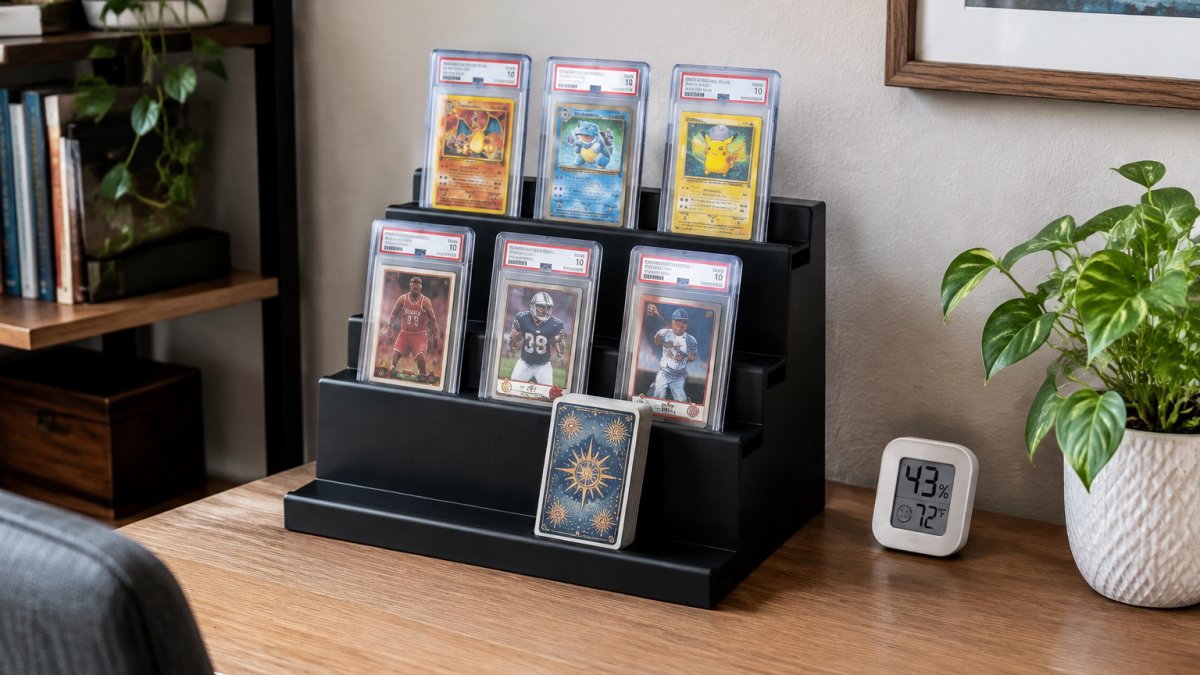
Our modular, expandable 3D-printed stands are built to sit on a shelf or desk, so you can arrange slabs and decks without drilling into a wall. If you have a large collection, our guide on how to store heavy card collections safely covers weight and humidity together.
Recovering Warped or Curled Cards: What Actually Works
Mild warping is often reversible. Severe warping usually is not, and pressing a badly damaged card can make it worse.
What works:
- Move the card to a stable, moderate-humidity room and let it rest flat for a few weeks
- Place it under a flat, even weight with a clean acid-free barrier between weight and card
- Store it in a rigid holder once it flattens
What does not work: hair dryers, direct sun, irons, or heavy books stacked overnight. These cause sudden moisture swings that crack the foil.
A common mistake is trying to fix a curl in a dry room. Dry air pulls more moisture out and makes the bend worse. Flatten in stable air, then seal it in a top loader.
Frequently Asked Questions
Is humidity bad for trading cards?
Yes. Card stock is paper-based, so it absorbs moisture from the air. When humidity swings, cards expand and contract unevenly, which causes warping, foil curling, and long-term damage. High humidity also raises the risk of mold and foxing. Keeping your collection in a stable, moderate humidity range and monitoring it with a hygrometer is the simplest way to protect trading cards from moisture damage over decades.
Do PSA slabs protect cards from humidity?
A PSA slab seals the card inside hard plastic, which slows moisture exchange, but it is not airtight. In a damp room, humidity can still reach the card over time. Treat slabs as one layer of protection and store them in a climate-controlled space with a hygrometer and, where needed, desiccant packets or two-way humidity control packs. The same applies to other graded cases and top loaders.
What is the best humidity pack for trading cards?
Two-way humidity control packs are the best humidity packs for MTG cards and other TCGs because they both absorb and release moisture to hold a steady level. Silica gel desiccant packets only absorb, so they can over-dry cards if used without monitoring. Choose a pack sized to your storage container, check it with a calibrated hygrometer, and replace it on the schedule the manufacturer gives.
How do I know if my trading cards have humidity damage?
Look for warping or bowing when a card sits flat, foil that curls at the edges, a wavy or rippled surface, and any musty smell or dark spots that suggest mold. Compare a suspect card against a known flat card on a level surface. If damage is recent and mild, moving the card to a stable, moderate-humidity environment with gentle weight and airflow can reduce warping, but creases and mold stains are permanent.
Humidity is the one threat you can beat with a hygrometer, a few desiccant packs, and the right storage setup. If your collection deserves to be seen, not buried in a box, The Card Shelf Workshop builds self-standing, modular display stands with tiered configurations and custom orders to fit your slabs and decks. Get started with The Card Shelf Workshop and display your collection with confidence.
